
 by Mit Thakkar
Summarize this blog post with:


- Top 15 Application Security Testing Tools to Use in 2026
- What Is Application Security Testing?
- Why Application Security Testing Matters in 2026
- ➥ Increasing application and API vulnerabilities
- ➥ Growing adoption of cloud-native applications
- ➥ Rise in automated and AI-assisted cyberattacks
- ➥ Increasing compliance and data protection requirements
- ➥ Need for continuous security testing in DevSecOps
- What to Look for in an Application Security Testing Tool
- ➜ Security Testing Capabilities
- ➜ Automation and CI/CD Integration
- ➜ Vulnerability Detection and Reporting
- ➜ Ease of Use and Scalability
- ➜ Pricing and Deployment
- Top 15 Application Security Testing Tools in 2026
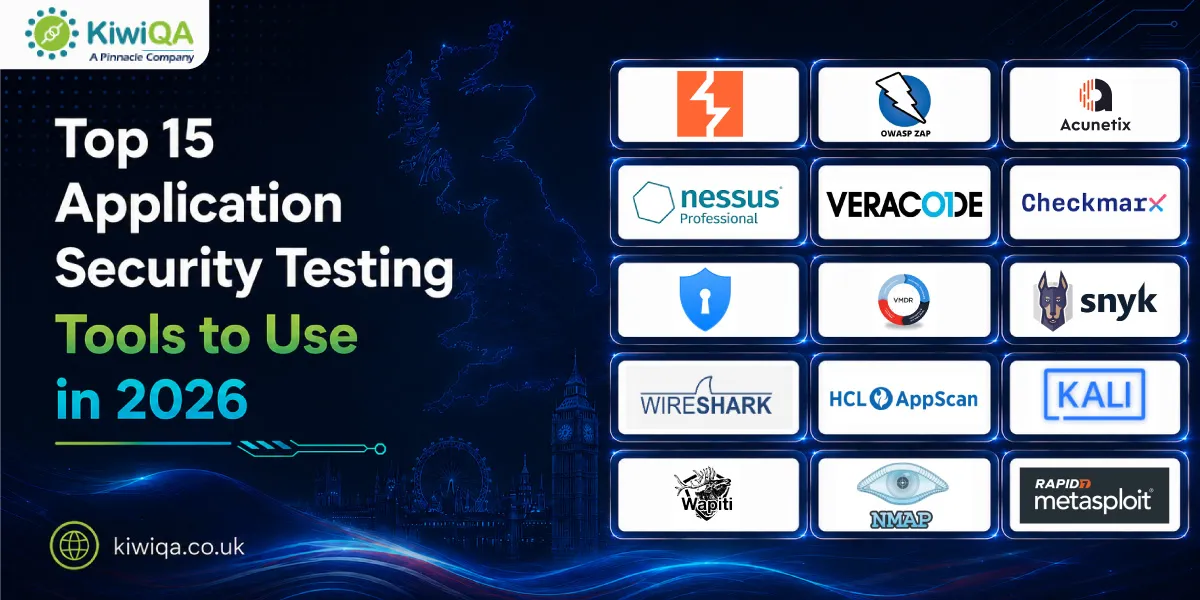
- 1. Burp Suite
- 2. OWASP ZAP
- 3. Acunetix
- 4. Nessus Professional
- 5. Veracode
- 6. Checkmarx
- 7. Fortify
- 8. block8.ai
- 9. Snyk
- 10. Wireshark
- 11. AppScan
- 12. Kali Linux
- 13. Wapiti
- 14. Nmap (Network Mapper)
- 15. Metasploit
- How to Choose the Right Application Security Testing Tool
- ❏ For Startups and Small Businesses
- ❏ For Enterprises
- ❏ For Developers
- ❏ For Security Teams
- Application Security Testing Best Practices for 2026
- ⮞ Test security early in the SDLC
- ⮞ Continuously test APIs and web applications
- ⮞ Integrate security testing into CI/CD pipelines
- ⮞ Prioritize vulnerabilities based on business risk
- ⮞ Retest vulnerabilities after remediation
- Choose the Right Application Security Testing Tool for Your Business
Top 15 Application Security Testing Tools to Use in 2026
Application security testing becomes necessary in 2026 as firms face rising cyber breaches and complex digital environments. Security testing services allow firms to identify gaps before anyone and safeguard apps, users, and data. The rising use of mobile, web, API, and cloud apps has also extended attacks, and it makes frequent security assessments more necessary. According to Veracode’s reports, 50% of firms have security debt, highlighting the importance of security testing. Application security testing tools support teams in monitoring errors, misconfigurations, insecure dependencies, and other risks throughout the SDLC.
However, no single tool matches every organization’s goals. The ideal selection depends on the app type, QA requirements, team expertise, security goals, and budget. By selecting tools that fulfill individual needs, firms can strengthen app security. The tools mentioned below help businesses with secure development practices and address errors before they become costly to fix. Read the next sections to learn about tools used by a security testing company, their use case, and features.
What Is Application Security Testing?
This is the methodology of identifying and addressing security weaknesses in software before hackers detect them. It measures apps throughout their lifecycle using automated and manual approaches. Manual testing involves expert-driven assessments, whereas automated testing uses specialized tools. Security testing is integrated across the SDLC and DevSecOps process for ongoing safety.
Why Application Security Testing Matters in 2026
➥ Increasing application and API vulnerabilities
Partnering with Security testing companies is crucial for finding and fixing vulnerabilities because growing application and API vulnerabilities increase attack opportunities.
➥ Growing adoption of cloud-native applications
Complex architectures, APIs, containers, and distributed environments are introduced by cloud-native applications, necessitating thorough security testing at every stage of development.
➥ Rise in automated and AI-assisted cyberattacks
Organizations need to strengthen application defenses through proactive and ongoing security testing because automated and AI-assisted attacks can find and exploit vulnerabilities more quickly.
➥ Increasing compliance and data protection requirements
Security testing services are crucial for identifying threats, safeguarding private data, and fulfilling legal requirements due to stricter compliance and data protection regulations.
➥ Need for continuous security testing in DevSecOps
DevSecOps teams can detect errors during the initial SDLC with the help of continuous security testing, which speeds up remediation and lowers security risks.
Also Read: Security Testing for SaaS Products: A CTO’s Checklist
What to Look for in an Application Security Testing Tool
➜ Security Testing Capabilities
Select a tool that supports the security testing techniques such as SAST, DAST, IAST, API security testing, and mobile application testing that your applications need. Finding flaws in various application components and technologies also requires robust vulnerability scanning capabilities. Security teams can develop a more comprehensive application security testing strategy with the support of broad coverage.
➜ Automation and CI/CD Integration
Automation helps teams find gaps early and minimizes manual labor. Seek out continuous testing, automated vulnerability reporting, CI/CD pipeline integration, and automated security scans. These features help developers fix problems before applications are put into production. It enables security checks to run consistently throughout the SDLC.
➜ Vulnerability Detection and Reporting
Common application security threats, such as known CVEs and vulnerabilities included in the OWASP Top 10, should be identified by efficient tools. Check out risk prioritization that allows teams to focus on important problems first. In-depth security reports and useful remediation suggestions can make vulnerability analysis even easier and assist developers in effectively fixing security flaws.
➜ Ease of Use and Scalability
An application security testing tool should be simple to use for developers and security experts without adding unnecessary complexity to the workflow. Take into account support for large applications, developer-friendly workflows, and user-friendly interfaces. Organizations that manage multiple teams, environments, applications, or security testing projects at once can also benefit from multi-project capabilities.
➜ Pricing and Deployment
Before choosing a software security testing tool, take into account its deployment options and pricing model. While commercial licensing may offer advanced features and enterprise support, free and open-source tools may be more appropriate for smaller teams. While on-premise deployment might be more appropriate for companies with particular security, compliance, or infrastructure needs, cloud-based deployment offers flexibility.
Top 15 Application Security Testing Tools in 2026
1. Burp Suite

One of the most popular tools for security assessment and web application penetration testing is Burp Suite. It offers an integrated environment for finding and verifying vulnerabilities like cross-site scripting, SQL injection, authentication flaws, and access-control problems. Both automated and manual testing workflows are supported by its Proxy, Scanner, Repeater, Intruder, and extensions.
Additionally, Burp Suite can assist security teams in integrating testing into development processes and automating routine security checks. Penetration testers, application security experts, and ethical hackers will find it especially helpful. Even though it has a lot of features, it might take some time for new users to become proficient with the platform.
2. OWASP ZAP

The main purpose of OWASP ZAP, a free and open-source application security testing tool, is to identify weaknesses in web applications. It offers tools for manual penetration testing in addition to supporting automated vulnerability scanning. Security experts can look into application security issues using its proxy, passive/active scanning, and scripting features.
Development teams can incorporate security checks during software delivery by integrating ZAP into CI/CD pipelines. Since it is open-source, it is a desirable choice for businesses with limited security budgets. Developers, security testers, students, and teams searching for an accessible web application security testing solution will find it especially useful.
3. Acunetix

Acunetix is an automated web vulnerability scanner made to assist companies in finding security issues in web apps, websites, and APIs. SQL injection, cross-site scripting, misconfigurations, and other typical application security problems are among the vulnerabilities it can identify. Teams can reduce manual testing effort with the platform’s automated scanning, vulnerability prioritization, reporting, and security monitoring features.
Acunetix can be helpful for businesses that manage several applications because it is made to work with modern web technologies. It is especially useful for security teams that require regular vulnerability assessments because of its automation capabilities. It works best for companies looking for centralized vulnerability management and streamlined web application security testing.
4. Nessus Professional

A popular vulnerability assessment tool for finding security flaws in networks, systems, devices, and apps is Nessus Professional. It is used to find vulnerabilities, configuration issues, missing patches, and other security risks that could leave an organization vulnerable. Security teams can perform routine assessments and prioritize security fixes with the help of its comprehensive vulnerability database and scanning capabilities.
Penetration testers, security administrators, IT teams, and companies conducting compliance-focused security evaluations can all benefit from Nessus Professional. By finding weaknesses in supporting systems and infrastructure, it may improve application testing. Teams can more effectively communicate security findings thanks to its reporting capabilities.
5. Veracode

Veracode offers an application security platform with an enterprise focus that incorporates security testing at every stage of the SDLC. Before problems reach production, development teams can use Veracode to find vulnerabilities in source code, third-party components, and running applications.
Additionally, the platform facilitates compliance requirements, reporting, recovery guidance, and developer workflows. Veracode is especially useful for companies that oversee distributed application portfolios and sizable development environments. Its centralized approach integrates security practices into modern software delivery processes and promotes collaboration between security and development teams on vulnerability management.
6. Checkmarx

An enterprise application security platform called Checkmarx was developed to simplify security testing in modern DevSecOps settings. Its capabilities include software composition analysis, infrastructure-as-code security, API security, and static application security testing. Development teams can find vulnerabilities earlier in the SDLC by incorporating security checks.
Additionally, Checkmarx offers tools for centralized security management, remediation, and vulnerability prioritization. Organizations with advanced application portfolios and established DevSecOps procedures will find it especially useful. Through automated and ongoing security testing, teams can use the platform to increase visibility into application risks while lowering the possibility that vulnerabilities will find their way into production environments.
7. Fortify

Fortify is a comprehensive application security platform designed to support businesses in finding and fixing software bugs at every stage of the development process. Teams can examine both running applications and application code thanks to its support for both static and dynamic application security testing. Coding flaws, security flaws, and vulnerabilities that could expose apps to attacks can be found with the help of Fortify.
Development pipelines, security operations, and vulnerability management procedures are all supported by its enterprise integrations. Organizations that need extensive application security coverage across intricate software environments can benefit from the platform. Fortify is helpful for companies implementing DevSecOps and structured application security programs because it can assist security teams in establishing consistent testing procedures throughout development stages.
8. block8.ai

Block8.ai is an AI-powered penetration testing platform designed to help organisations identify, validate, and prioritise security vulnerabilities across web applications and external infrastructure. It combines automated testing with expert validation to uncover exploitable weaknesses, reduce false positives, and provide practical remediation guidance for security teams.
Among application security testing tools, Block8.ai is useful for businesses looking to strengthen web application security, improve vulnerability management, support compliance requirements, and conduct scalable penetration testing. Its focus on validating real-world security risks helps organisations better understand which vulnerabilities require immediate attention.
9. Snyk

Snyk is a security platform targeted at developers that finds vulnerabilities in source code, containers, infrastructure-as-code configurations, and application dependencies. Teams can identify risks in third-party components and open-source packages with the help of its software composition analysis capabilities. Prior to deployment, Snyk can also check infrastructure-as-code files and container images for security flaws.
Security checks can be incorporated into regular development workflows through integration with source-control platforms, CI/CD pipelines, and developer tools. Because of this, Snyk is especially appropriate for companies that use DevSecOps. Snyk helps teams find and fix vulnerabilities earlier by bringing security testing closer to developers. It lowers remediation effort and improves security throughout the SDLC.
10. Wireshark

Security experts can record and thoroughly examine network traffic using Wireshark, a popular network protocol analyzer. These web application security testing tools can be useful for penetration testing and application security assessments. To look into possible security problems, security teams can examine protocols, requests, responses, connections, and unusual traffic patterns.
Wireshark offers comprehensive packet-level visibility and supports a wide variety of network protocols. Security analysts, network administrators, penetration testers, and developers troubleshooting application communications will find it especially helpful. Insecure protocols, unexpected data transmission, authentication issues, and other network-level security issues can all be found with the help of its thorough traffic analysis.
11. AppScan

This tool helps businesses find vulnerabilities in web apps and APIs. It can detect security flaws in active applications through automated evaluations and supports dynamic application security testing. Additionally, AppScan offers enterprise security teams reporting features, vulnerability analysis, and API testing capabilities.
It can be used by organizations to incorporate security testing into more general risk management and application development procedures. Teams can prioritize vulnerabilities and share findings with technical and business stakeholders with the help of its reporting capabilities. Businesses that require organized web and API security testing across various applications and development environments will find AppScan especially useful.
12. Kali Linux

Kali Linux is a security tool with a vast array of tools for measuring errors, penetration testing, and security research. Instead of being a single application security testing tool, Kali gives security experts access to a variety of tools that they can use at various stages of testing. Network discovery, web application testing, password auditing, exploitation, wireless security testing, and forensic analysis are all part of its toolkit.
Cybersecurity students, ethical hackers, penetration testers, and security researchers all frequently use Kali Linux. Its wide range of tools makes it appropriate for thorough security evaluations. However, to use the various tools efficiently, users typically need technical expertise.
13. Wapiti

For black-box security testing, Wapiti is a lightweight, free testing tool. It looks for common vulnerabilities in web applications by crawling accessible pages and testing forms, parameters, and other accessible components. Security experts who favor automated scripts and lightweight testing environments will find it especially helpful as a command-line tool.
For developers, penetration testers, and security researchers performing targeted web application evaluations, Wapiti is an excellent choice. It is also a useful choice for teams looking for a straightforward scanning solution because it is open-source.
14. Nmap (Network Mapper)

Nmap is an effective tool for network discovery and security auditing that is frequently used to find hosts, open ports, services, operating systems, and network configurations. Nmap’s Network Scripting Engine offers scripts that can assist security experts in identifying particular vulnerabilities and security conditions, even though it is not a dedicated application vulnerability scanner.
Nmap is frequently used in penetration testing to identify unsecured services and comprehend the network environment that supports an application. Additionally, it can be integrated into workflows for automated security assessments. Network administrators, security researchers, and penetration testers will find the tool especially helpful. It is useful for network and security assessments due to its versatility, scripting capabilities, and broad community support.
15. Metasploit

Metasploit is a framework for penetration testing and security assessment that is used to verify vulnerabilities and assess system and application security. Within approved security assessments, it offers modules for vulnerability validation, exploitation, payload creation, auxiliary testing, and post-exploitation tasks.
Metasploit is one of the top application security testing tools that security experts can use to assess the potential impact of vulnerabilities. Teams that are seeking results rather than just identifying them will find the framework especially helpful. Metasploit should only be used in approved testing environments with suitable safeguards and clearly defined testing boundaries.
How to Choose the Right Application Security Testing Tool
❏ For Startups and Small Businesses
Small businesses and startups should give priority to inexpensive, user-friendly solutions that meet critical security needs. Software security testing can help find issues before system errors occur. While tools with necessary web and API security testing capabilities offer useful protection without unnecessary complexity, open-source solutions can lower costs.
❏ For Enterprises
Businesses should select solutions that offer centralized reporting and visibility while scaling across teams, environments, and applications. Make risk prioritization, vulnerability management, and robust compliance support your top priorities. Integrating security testing into established development and deployment workflows also requires integration with current DevSecOps tools and CI/CD pipelines.
❏ For Developers
The mobile application security testing tools should be selected by developers based on how well they align with their current workflows. Early detection of code and dependency vulnerabilities is possible with developer-friendly SAST and SCA capabilities. Security checks can be made easier by integrating IDEs and Git, and quick feedback allows developers to identify and resolve problems without slowing down development.
❏ For Security Teams
For more thorough application evaluations, security teams usually require advanced capabilities. Find penetration testing and DAST features that enable thorough vulnerability validation and assist in verifying actual security threats. Managing recurring assessments, prioritizing vulnerabilities, monitoring fixes, and sharing security findings throughout the company all benefit from robust automation and reporting capabilities.
Also Read: Top Security Testing Company in UK for Compliance and Data Protection
Application Security Testing Best Practices for 2026
⮞ Test security early in the SDLC
To lower remediation costs and stop issues from reaching production, find security flaws during development.
Combine automated and manual testing
For comprehensive coverage, use automated scanning; for complex vulnerabilities that automated tools may overlook, use manual testing.
⮞ Continuously test APIs and web applications
Examine web apps and APIs frequently to find new vulnerabilities, configuration problems, and changing security risks.
⮞ Integrate security testing into CI/CD pipelines
In order to find and fix vulnerabilities prior to deployment to production environments, incorporate automated security checks into CI/CD pipelines.
⮞ Prioritize vulnerabilities based on business risk
To concentrate remediation efforts on critical risks, assess vulnerabilities based on their severity, exploitability, impact on business, and affected assets.
⮞ Retest vulnerabilities after remediation
Review the vulnerabilities that have been fixed to make sure the fix was successful and to ensure security modifications haven’t caused any new problems.

Choose the Right Application Security Testing Tool for Your Business
Selection of an ideal app security testing tool begins with your goals. For web app testing tools like Burp Suite, OWASP ZAP is an ideal option, whereas Metasploit helps with penetration testing. A reliable security testing company also helps select and implement suitable solutions. Prioritize app type, scalability, and budget while choosing the best application security testing tools for better support. Partner with a security testing team from a reputed QA company.










Comments are closed.