
 by Mit Thakkar
Summarize this blog post with:


- CRM Testing Process: A Complete Guide for Better CRM Performance
- What Is CRM Testing?
- ➥ Definition of CRM Testing
- ➥ Why CRM Testing Matters
- Why Partner with a Professional CRM Testing Company?
- ⮚ Access to experienced QA professionals
- ⮚ Faster testing cycles
- ⮚ Automation expertise
- ⮚ Reduced business risks
- ⮚ Comprehensive test coverage
- ⮚ Cost-effective testing strategy
- ⮚ Improved CRM performance
- When Should You Perform CRM Testing?
- ➥ Before CRM implementation
- ➥ Before major upgrades
- ➥ After customization
- ➥ Following third-party integrations
- ➥ During data migration
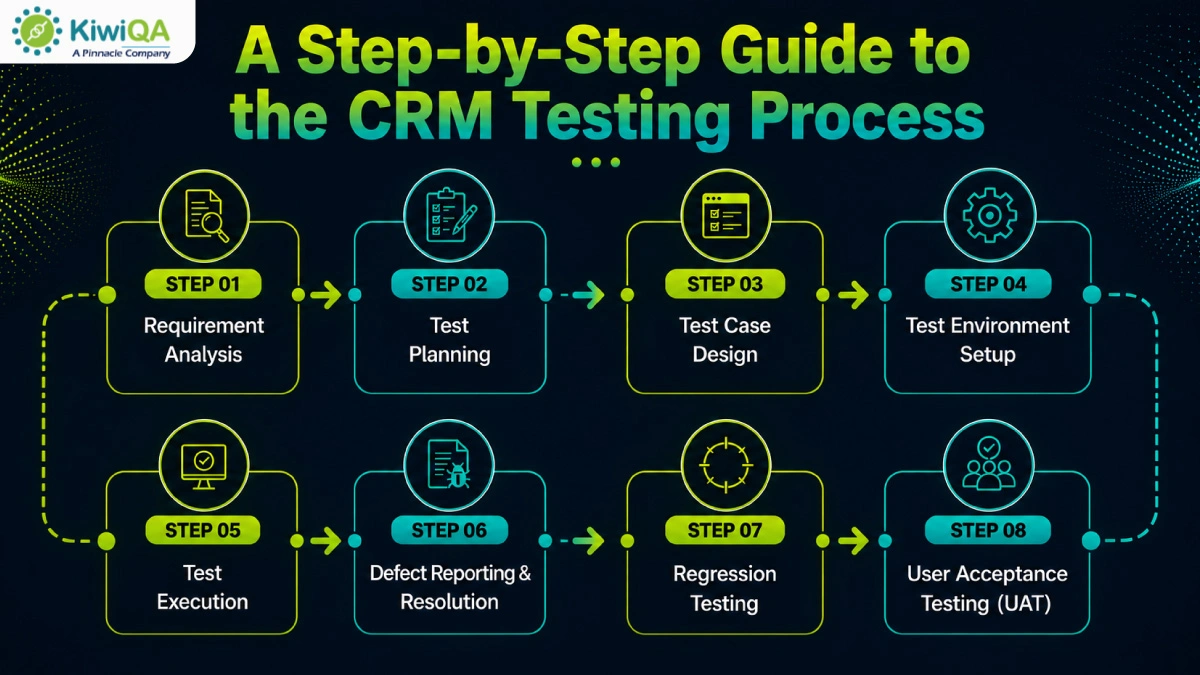
- A Step-by-Step Guide to the CRM Testing Process
- ⮚ Step 1: Requirement Analysis
- ⮚ Step 2: Test Planning
- ⮚ Step 3: Test Case Design
- ⮚ Step 4: Test Environment Setup
- ⮚ Step 5: Test Execution
- ⮚ Step 6: Defect Reporting and Resolution
- ⮚ Step 7: Regression Testing
- ⮚ Step 8: User Acceptance Testing (UAT)
- Types of CRM Testing Every Business Should Perform
- ➥ Functional Testing
- ➥ Integration Testing
- ➥ Performance Testing
- ➥ Security Testing
- ➥ Usability Testing
- ➥ Compatibility Testing
- ➥ Regression Testing
- Complete CRM Testing Checklist for Better System Performance
- ⮚ Verify login and authentication
- ⮚ Validate customer data accuracy
- ⮚ Test lead management
- ⮚ Verify contact management
- ⮚ Test opportunity management
- ⮚ Validate workflow automation
- ⮚ Check reports and dashboards
- Best Practices for Effective CRM Testing
- ➥ Create realistic test scenarios
- ➥ Automate repetitive test cases
- ➥ Test with multiple user roles
- ➥ Perform regular regression testing
- ➥ Validate security at every stage
- Benefits of an Effective CRM Testing Process
- ⮚ Improved CRM reliability
- ⮚ Better customer experience
- ⮚ Increased employee efficiency
- ⮚ Reduced operational risks
- ⮚ Faster software releases
- ⮚ Stronger data security
- Ready to Improve Your CRM Performance with Expert Testing?
CRM Testing Process: A Complete Guide for Better CRM Performance
For many organizations, CRM systems are necessary for maintaining customer data, organizing user interactions, and driving sales. Since reliability is necessary for business success, businesses must ensure that the CRM system is working properly. It must be tested frequently for any issues, and the process is called Salesforce CRM testing services.
To keep your business competitive, perform CRM testing to make sure sales, data, and reports work before and after release. 37% of CRM users report lost revenue due to poor data quality. CRM testing validates that customer records are updated, created, stored & removed accurately.
We can call CRM testing a vital system of modern business since it manages marketing & sales to customer services and revenue growth opportunities. CRM with any fault can hamper an organization’s ability to obtain and expand customer relationships. To avoid the basic mistakes here in this blog, we have shared the step-by-step process for CRM testing services.
What Is CRM Testing?
➥ Definition of CRM Testing
In a business, the customer is the key to success. CRM testing services are a crucial part of ensuring user satisfaction. CRM testing is a process that validates the functionality and performance of CRM systems to ensure that they match the needs of their users.
This type of CRM software testing helps to identify potential errors in a system so that they can be resolved before they become a problem for users. Additionally, it can offer valuable metrics into how the system is being used and what improvements can be made to match users’ expectations. CRM testing refers to the validation processes supporting a financial CRM system to match business goals. Testing validates that the CRM platform manages vital workflows flawlessly.
➥ Why CRM Testing Matters
➭ Ensures business process accuracy
CRM testing validates that necessary workflows, including lead management, sales automation, customer support, and reporting, operate accurately. Accurate processes limit operational risks, drive efficiency, and ensure the team can manage user interactions.
➭ Prevents costly system failures
Brief CRM testing detects errors before release, while limiting the risk of breakdowns. It helps businesses avoid disruptions and data loss. Early error detection lowers maintenance costs and avoids expensive fixes after CRM goes live.
➭ Improves customer experience
A well-designed CRM delivers consistent performance, accurate user information, and seamless interaction across sales and support. It helps firms to respond faster, resolve errors efficiently, and build stronger customer relationships.
➭ Enhances employee productivity
CRM testing verifies employees can access reliable features, automated workflows, and accurate data without interruptions. A stable system limits manual work, reduces errors, and enables the team to complete tasks efficiently every day.
➭ Protects sensitive customer data
Testing validates the CRM security controls, authentication, user permissions, and data safety. It helps to avoid unauthorized access, safeguards user information, and supports compliance with industry regulations and standards.
Why Partner with a Professional CRM Testing Company?
⮚ Access to experienced QA professionals
A professional Salesforce testing company utilizes skilled QA expertise with extensive experience in CRM platforms, QA processes, and industry best practices. The expertise ensures accurate error detection, comprehensive validation, and high quality throughout the SDLC.
⮚ Faster testing cycles
The skilled QA team uses proven processes, automation frameworks, and effective workflows to drive testing activities. Quick QA cycles limit project delays, allow quick error resolution, and support firms in launching CRM solutions within planned timelines.
⮚ Automation expertise
Expert QA leverages advanced automation tools to execute repetitive test cases effectively. Automated QA enhances accuracy, drives testing speed, limits manual efforts, and supports frequent QA testing throughout CRM updates & release.
⮚ Reduced business risks
Comprehensive CRM testing tracks functional, performance, and security errors before release. Early error detection limits operational errors, avoids costly failures, and safeguards user data. It reduces business risks associated with unstable CRM implementation.
⮚ Comprehensive test coverage
The skilled CRM testing company validates every crucial component, including workflows, security, performance, and usability. Complete test coverage ensures no essential functionality is overlooked.
⮚ Cost-effective testing strategy
CRM testing eliminates the requirement to develop and manage an in-house QA team. Organizations reduce recruitment, training, and infrastructure costs while gaining access to a specialized team.
⮚ Improved CRM performance
A professional Salesforce testing service provider optimizes CRM speed, stability, and scalability under real-world conditions. The high-performing CRM drives employee productivity, delivers improved user experience, minimizes downtime, and supports long-term business growth.
Also Read: Top 10 CRM Testing Company in UK for Scalable CRM Quality Assurance
When Should You Perform CRM Testing?
➥ Before CRM implementation
Perform CRM software testing before release to validate that the configuration, workflows, and organizational demands are accurately implemented. Early QA helps to identify errors before users access the systems, reduce release risks, and ensure a smooth release.
➥ Before major upgrades
Businesses must test CRM prior to installing major software updates. It ensures new features, configurations and system changes work as expected without hampering current functionality or impacting business operations.
➥ After customization
Each module, workflow, and dashboard must be thoroughly tested after development. QA confirms that customization meets business demands and functions accurately.
➥ Following third-party integrations
When the CRM is integrated with the ERP system, marketing tools, payment gateways, and 3rd-party apps, testing is necessary. It validates data synchronization, API performance, and seamless communication between connected systems.
➥ During data migration
CRM testing is necessary throughout data migration to validate that customer records, transactions, and data are moved safely. It helps identify missing or duplicate data while ensuring data integrity throughout the migration.
A Step-by-Step Guide to the CRM Testing Process
⮚ Step 1: Requirement Analysis
An efficient CRM testing process starts with requirement analysis. In order to comprehend how the CRM should perform, testers examine user stories, functional specifications, and business requirements throughout this phase. They specify expected results, set testing goals, and look at important processes, including lead management, sales funnels, customer service, and reporting.
It’s equally crucial to comprehend compliance standards and third-party application integrations. A comprehensive requirement analysis reduces the possibility of overlooking crucial features that could affect users after deployment. It helps remove errors and guarantees that test coverage is in line with business objectives.
⮚ Step 2: Test Planning
The process for carrying out CRM testing effectively is described in the test planning. Teams choose the right testing categories, such as functional, performance, security, usability, and integration testing. Specific tasks are assigned to team members like automation engineers, testers, and business stakeholders.
During this stage, deadlines, benchmarks, risk evaluations, and testing methods are also established. A thorough test strategy guarantees maximum resource utilization, enhances coordination, and shortens project delays. It offers an organized method for providing a scalable CRM system that satisfies business requirements.
⮚ Step 3: Test Case Design
In order to check each CRM functionality against business objectives, test case design involves creating comprehensive scenarios. Functional test cases covering essential procedures, including contact management, opportunity tracking, workflows, dashboards, and client interactions, are created by testers.
To verify how the system responds to incorrect inputs, improper permissions, or unexpected user behavior, negative test scenarios are incorporated. Boundary condition testing guarantees that the CRM operates appropriately under edge cases and data constraints. In addition to increasing requirement coverage, improving testing accuracy, and making fault identification easier, well-designed test cases are necessary.
⮚ Step 4: Test Environment Setup
To guarantee reliable validation, a well-configured test environment resembles the production CRM environment. This includes setting up user roles, permissions, workflows, and security settings in addition to installing and configuring the CRM platform. To replicate actual business processes while upholding privacy and compliance, sample customer data is imported.
Additionally, necessary integrations with marketing tools, payment gateways, ERP systems, and communication platforms are set up and validated. In addition to increasing test reliability and reducing false failures, a stable test environment helps teams find real application problems prior to release.
⮚ Step 5: Test Execution
Testers conduct predetermined manual and automated test cases to verify CRM functionality during test execution. While automated scripts speed up repetitive tasks, manual testing assesses usability, business procedures, and intricate user interactions. Testers record any inconsistencies or failures by comparing real and predicted findings. To facilitate quicker resolution, defects are documented. Good test execution guarantees thorough validation and finds hidden problems early. It verifies that the CRM operates consistently across various user scenarios and devices.
⮚ Step 6: Defect Reporting and Resolution
Defect reporting and resolution ensure that CRM problems are found, prioritized, and effectively fixed. Before being allocated to the proper development team, each defect is categorized according to its severity. Testers work closely with developers to understand problems and verify implemented solutions.
Defects are retested after fixes to ensure they have been successfully resolved without impacting other functionalities. An organized defect management procedure guarantees that the CRM is stable before production deployment. It validates the software quality, shortens turnaround times, and improves communication.
⮚ Step 7: Regression Testing
Regression testing confirms that recently added updates have not adversely impacted the functionality of the CRM. To ensure that essential functionality like customer management, workflows, reporting, integrations, and user permissions continues to operate as intended, testers re-perform previously completed test cases. Automated regression testing improves consistency and drastically cuts down on execution time. Before releasing the updated CRM system, this stage gives organizations more confidence by helping to uncover hidden errors and maintain app stability.
⮚ Step 8: User Acceptance Testing (UAT)
The last stage of validation is called UAT, during which business users confirm that the CRM satisfies operational needs and facilitates practical workflows. Using actual business scenarios, stakeholders test crucial procedures including sales management, customer support, reporting, and automation.
Before production deployment, feedback is gathered to find any usability issues or functional deficiencies. Stakeholders formally authorize the system’s release following successful validation. UAT ensures the CRM is in line with corporate goals, boosts user confidence, and reduces post-launch problems.
Types of CRM Testing Every Business Should Perform
➥ Functional Testing
Functional testing confirms that each CRM functionality operates in accordance with business needs. It verifies data processing, user actions, automation rules, CRM modules, and business workflows. This testing helps companies offer accurate results while reducing errors. It enhances overall system reliability by ensuring sales, marketing, and customer service operations run smoothly.
➥ Integration Testing
Integration testing guarantees that the CRM accurately exchanges data with third-party APIs, marketing platforms, payment gateways, and ERP systems. It ensures uninterrupted business workflows, prevents synchronization problems, and certifies smooth communication between linked apps. This testing promotes uniform operating efficiency across corporate systems and lowers integration risks.
➥ Performance Testing
Performance testing assesses the CRM’s functionality in various workload scenarios. This procedure finds performance bottlenecks and guarantees reliable operation during periods of high traffic. This testing gets the CRM ready to support future business expansion without interruption.
➥ Security Testing
By verifying data encryption, user authentication, authorization rules, and vulnerability management, security testing safeguards private client and corporate data. It detects possible security flaws before deployment, lowering the possibility of cyberattacks. The testing facilitates regulatory compliance and enhances the CRM platform’s general security and reliability.
➥ Usability Testing
Usability testing evaluates how simple it is to understand and utilize the CRM. To guarantee a good user experience, it assesses workflow efficiency, accessibility, navigation, and UI design. The testing boosts CRM adoption across all organizational departments, decreases training time, promotes productivity, and minimizes user errors.
➥ Compatibility Testing
The CRM’s consistency across various browsers, devices, operating systems, and screen sizes is validated by compatibility testing. It guarantees that consumers get the same reliable experience. This testing facilitates smooth communication for remote and mobile workforces. It enhances accessibility and helps get rid of device-specific problems.
➥ Regression Testing
Regression CRM testing checklist confirms that current CRM functionality is unaffected by new upgrades, improvements, and issue fixes. To verify feature stability, process consistency, and application reliability, it runs previously validated scenarios again. This testing guarantees that the CRM continues to provide quality performance with each release.
Complete CRM Testing Checklist for Better System Performance
⮚ Verify login and authentication
Salesforce CRM testing services verify the proper operation of user access controls, MFA, password recovery, and login. With Salesforce CRM testing services, organizations can ensure that, according to their allocated responsibilities and permissions, only authorized people can access CRM data.
⮚ Validate customer data accuracy
Check that account information, contact details, and customer records are appropriately kept, updated, and retrieved. Examine all CRM modules for consistent data, missing fields, and duplicate records.
⮚ Test lead management
Verify the proper operation of the lead generation, assignment, and conversion processes. Throughout the whole sales process, confirm automated status updates, notifications, and tracking.
⮚ Verify contact management
Verify the accuracy and accessibility of customer interactions, communication history, and related information.
⮚ Test opportunity management
Verify the generation of opportunities, the advancement of sales stages, forecasting, revenue computations, and deal monitoring. Make sure users can effectively handle opportunities while keeping a correct overview of the sales pipeline.
⮚ Validate workflow automation
Check email notifications, task assignments, automated workflows, and approval procedures. Verify that automation rules run accurately, without errors, delays, or unintentional disruptions to workflow.
⮚ Check reports and dashboards
To enable well-informed business decisions and performance monitoring, confirm the reports & dashboards are visible accurately.
Best Practices for Effective CRM Testing
➥ Create realistic test scenarios
The testing professionals are advised to design test cases that closely reflect real business operations and user behavior. Use realistic customer data, sales processes, automation scenarios, and support workflows to monitor errors that may only appear in day-to-day CRM usage.
➥ Automate repetitive test cases
Automate repetitive & time-consuming test cases for smooth CRM testing. Automation enhances test speed, limits manual effort, drives accuracy, and supports frequent testing during CRM updates.
➥ Test with multiple user roles
CRM validation must be done using various user roles, including administrators, sales representatives, marketers, and managers. It verifies role-based permissions, data access, and workflow functions accurately across the firm.
➥ Perform regular regression testing
Execute regression QA after every update, bug fix, customization, or feature upgrade. Frequent testing validates that the current functionality remains stable, avoids unexpected errors, and manages consistent CRM performance throughout the SDLC.
➥ Validate security at every stage
Measure security throughout the QA process by validating authorization, authentication, access control, and data encryption. Frequent security verification helps avoid errors, safeguards crucial data, and ensures compliance with industry standards.
Also Read: Key Benefits of Automation Testing for Banking Applications
Benefits of an Effective CRM Testing Process
⮚ Improved CRM reliability
The CRM, which is well-tested, delivers consistent performance, stable functionality, and accurate business operations. It limits software errors, limits breakdowns, and ensures users can depend on the system for daily CRM activities.
⮚ Better customer experience
Effective CRM testing validates accurate customer data, quick response time, and seamless interactions across sales and support channels. The reliable system enhances service quality, drives user satisfaction, and strengthens long-term user relationships.
⮚ Increased employee efficiency
A stable CRM allows employees to complete tasks quickly without system errors. Reliable automation, accurate data, and intuitive functionality limit manual efforts. Testing also enhances productivity and supports teams’ focus on high-value organizational tasks.
⮚ Reduced operational risks
Comprehensive testing identifies performance, functional, and security errors before release. Early error detection avoids costly failures, reduces business disruptions, and protects crucial processes. It reduces the risks that could negatively impact organizational performance and user trust.
⮚ Faster software releases
Effective CRM testing streamlines QA through structured planning and automation. Quick defect detection and validation shorten QA cycles, allowing organizations to release new features and updates with great speed.
⮚ Stronger data security
CRM testing validates authentication, access controls, data protection, and encryption. Strong security QA reduces vulnerabilities, avoids unauthorized access, supports regulatory compliance, and builds trust.
Ready to Improve Your CRM Performance with Expert Testing?
CRM testing concepts are the key elements of business growth. It is necessary to test various designs and layouts to figure out which one offers quality outcomes. Testing CRM systems demands precision to run similar tests.
CRM testing is a complicated process and requires expertise. If you lack the technical proficiency, you can hire a Salesforce testing company. These companies focus on the core services and leverage the expertise of professionals. The professional team ensures that the CRM system is tested to high standards and works best for the firm.









Comments are closed.