

 by niranjan.limbachiya@kiwiqa.com
Summarize this blog post with:


Quick Summary
Choosing the right software testing partner is essential for delivering reliable, secure, and high-quality software while reducing release risks. The blog explains when businesses should consider external QA support, what factors to evaluate, questions to ask testing companies, and how to compare potential partners.
Key areas include industry expertise, testing capabilities, technical skills, automation, methodology, communication, scalability, security, client experience, and pricing. It also highlights red flags such as unclear processes, low pricing, poor communication, limited case studies, and one-size-fits-all testing.
- How to Choose the Right Software Testing Partner in the UK?
- Why Choosing the Right Software Testing Partner Matters
- ➥ Impact of software quality on customer experience
- ➥ Cost of bugs and production failures
- ➥ Importance of independent QA expertise
- ➥ Benefits of working with an experienced testing partner
- ➥ Why UK businesses need scalable testing support
- When Should You Hire a Software Testing Partner?
- Key Factors to Consider When Choosing a Software Testing Partner in the UK
- ⮞ Industry and Domain Experience
- ⮞ Range of Software Testing Services
- ⮞ Technical Expertise and Testing Tools
- ⮞ Test Automation Capabilities
- ⮞ Testing Process and Methodology
- ⮞ Communication and Collaboration
- ⮞ Scalability and Flexibility
- ⮞ Data Security and Compliance
- ⮞ Client Reviews and Case Studies
- ⮞ Pricing and Engagement Models
- Questions to Ask a Software Testing Company Before Hiring
- ➜ Testing Expertise
- ➜ Project Management
- ➜ Security and Quality
- ➜ Scalability and Support
- How to Compare Software Testing Companies in the UK
- ❏ Create a Shortlist
- ❏ Request a Consultation or Test Proposal
- ❏ Consider a Pilot Testing Project
- Red Flags to Watch for When Selecting a Testing Partner
- ► No clear testing methodology
- ► Unrealistically low pricing
- ► Limited reporting and communication
- ► No relevant case studies or references
- ► Lack of security and compliance practices
- ► One-size-fits-all testing approach
- Software Testing Partner Selection Checklist
- Benefits of Choosing the Right Software Testing Partner
- » Faster software releases
- » Reduced production defects
- » Better application performance
- » Improved user experience
- » Lower long-term QA costs
- » Increased test coverage
- » Greater confidence before release
- Ready to Choose the Right Software Testing Partner?
How to Choose the Right Software Testing Partner in the UK?
Software quality is essential for UK businesses looking for reliable digital products and satisfied customers. A trusted software testing company can help identify errors before release and reduce risks. However, an in-house QA team may face a lack of skills, resources, and time.
The ideal testing partner offers specialised expertise, improves QA efficiency, provides scalable testing, and supports faster releases as business requirements change. With 63% of organisations reportedly shipping code without fully testing it and 66% facing significant risk of software outages, choosing the right QA partner has become increasingly important. Read the following blog to learn how to identify the right software testing partner for your business.
Why Choosing the Right Software Testing Partner Matters
➥ Impact of software quality on customer experience
Reliable performance, decreased inconvenience, increased trust, and encouragement to keep using your product are all benefits of high-quality software.
➥ Cost of bugs and production failures
Revenue loss, customer frustration, operational difficulties, reputational harm, and costly emergency repairs can all result from production flaws.
➥ Importance of independent QA expertise
Independent testers identify missed problems and verify software quality without the biases of the development team.
➥ Benefits of working with an experienced testing partner
Experienced software testing consultancy improve overall software quality with their specialized skills, proven approaches, innovative tools, and effective procedures.
➥ Why UK businesses need scalable testing support
Businesses in the UK can better handle shifting workloads, quicker releases, expanding applications, and changing client expectations with the help of scalable software testing partners.
When Should You Hire a Software Testing Partner?
• Your internal QA team lacks specialised skills- Reliable performance, decreased inconvenience, increased trust, and encouragement to keep using your product are all benefits of high-quality software.
• Testing delays are slowing down releases- revenue loss, customer frustration, operational difficulties, reputational harm, and costly emergency repairs can all result from production flaws.
• Your application requires multiple testing types- independent testers identify missed problems and verify software quality without the biases of the development team.
• You need independent quality validation- Experienced software testing partner improves overall software quality with their specialized skills, proven approaches, innovative tools, and effective procedures.
• Your product is scaling quickly- Businesses in the UK can better handle shifting workloads, quicker releases, expanding applications, and changing client expectations with the help of scalable testing assistance.
• You need flexible testing resources- Depending on project demands, release deadlines, and evolving requirements, external testing partners can quickly add or decrease QA capacity.
Also Read: Types of Software Testing for UK Startups and Enterprises
Key Factors to Consider When Choosing a Software Testing Partner in the UK
⮞ Industry and Domain Experience
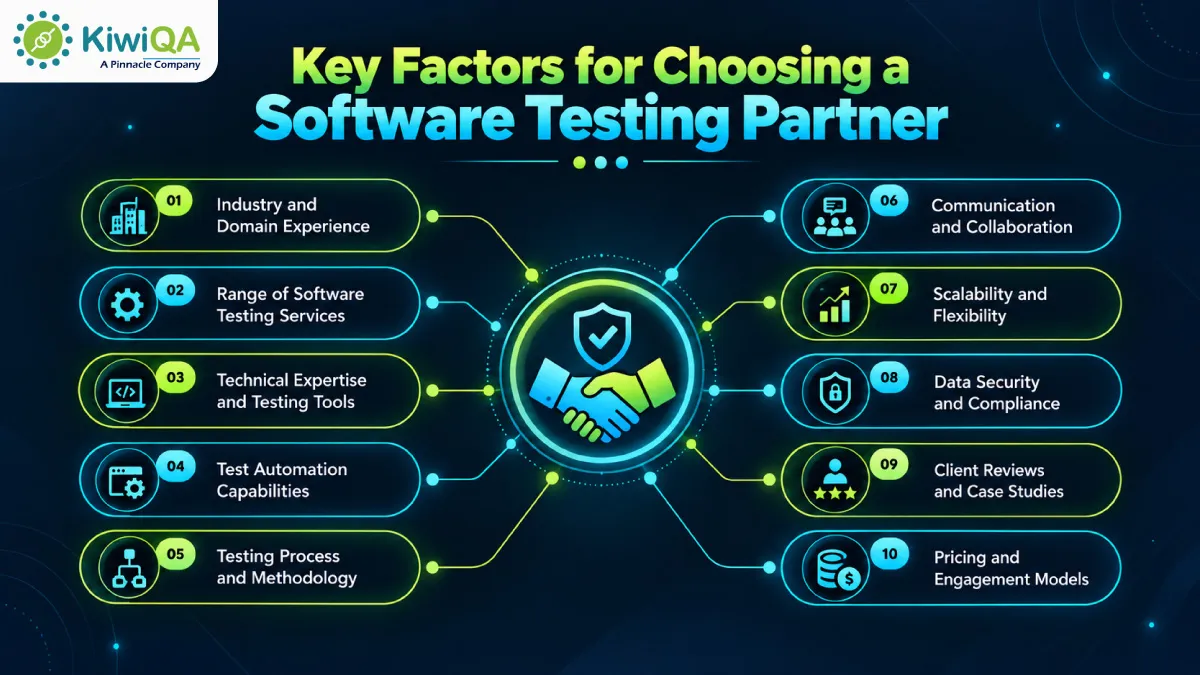
Select a testing partner who understands the specific problems of your sector and has experience in it. Their software testing services need to be consistent with your product, client expectations, and workflows. Additionally, industry expertise enables testers to quickly identify risks and satisfy relevant regulatory, quality, and compliance requirements without unnecessarily complex testing.
⮞ Range of Software Testing Services
Determine if the software testing company offers a wide range of testing capabilities in a single engagement. Manual and automated testing, functional testing, performance testing, security testing, API testing, mobile testing, and cross-browser testing are a few examples of this. As your application develops, you can manage various quality criteria with a larger service portfolio.
⮞ Technical Expertise and Testing Tools
A professional testing partner should be familiar with using modern tools like Appium, Playwright, Cypress, and Selenium. Check their understanding of modern QA frameworks and procedures in addition to tool familiarity. In order to facilitate quicker releases and ongoing quality assurance, they should also be able to incorporate testing operations with CI/CD pipelines.
⮞ Test Automation Capabilities
When used properly, test automation can increase testing speed, consistency, and regression coverage. Look for the best software testing partner who can create automation frameworks that are scalable and appropriate for your application. Their knowledge of regression and continuous testing is crucial for a well-defined plan for expanding, updating, and maintaining automated test suites as the product evolves.
⮞ Testing Process and Methodology
A reliable testing partner should adhere to a structured procedure that addresses error management, reporting, test design, and execution. Find out how they track problems during the development lifecycle, record results, and establish testing priorities. Monitoring progress and maintaining consistent testing results is made easier with transparent methodology and clear quality assurance standards.
⮞ Communication and Collaboration
When external testers collaborate with your development or product teams, effective communication is crucial. Keep an eye out for responsive communication channels, transparent reporting, and frequent project updates. Additionally, a dedicated point of contact can improve communication, improve problem-solving, and guarantee that testing priorities stay in line with your project objectives and release schedules.
⮞ Scalability and Flexibility
As the product develops, new features are introduced, or release deadlines become more rigorous, your testing needs may change. Select a software testing services company who offers flexible engagement models and can expand testing resources as needed. Additionally, when project requirements, objectives, technologies, or schedules change, they should be able to modify their testing methodology.
⮞ Data Security and Compliance
Sensitive application data, customer information, and business systems are frequently accessed during software testing. Evaluate the provider’s data protection and confidentiality practices before involvement. In addition to maintaining secure testing environments, controlled access, suitable data-handling practices, and protections, they should be aware of relevant GDPR standards.
⮞ Client Reviews and Case Studies
Case studies and client evaluations can offer significant proof of a testing provider’s expertise. Look for examples of projects that are comparable to yours in terms of complexity, industry, or technology. Keep an eye on measurable results, client testimonials, and long-term relationships. These qualities can reveal a provider’s reliability, expertise, and ability to produce consistent outcomes.
⮞ Pricing and Engagement Models
Instead of selecting a service based only on the lowest price, compare them based on transparent pricing. Costs, deliverables, timetables, and assumptions should all be explained in detail by a reputable software qa testing company. Think about which models—fixed-cost, time-and-materials, or dedicated-team best suit your needs. Your project’s scope, testing complexity, and expected outcomes should all be specified in the pricing structure.
Questions to Ask a Software Testing Company Before Hiring
➜ Testing Expertise
Ask about the company’s technical capabilities, industry experience, and testing specializations. Identify which testing frameworks and tools they use, as well as whether their experience fits your application, technology stack, industry standards, and overall quality goals.
➜ Project Management
Identify how the testing company manages communication, reporting, errors, and test preparation. Ask about the frequency of updates and whether a project manager or point of contact will be assigned to ensure efficient coordination.
➜ Security and Quality
Talk about how the custom software testing company maintains testing quality throughout the engagement and safeguards confidential project data. Ask about their testing requirements, access controls, security procedures, quality assurance procedures, and methods for ensuring consistent outcomes.
➜ Scalability and Support
Verify the testing team’s ability to adapt to changing project demands, workloads, and release dates. Additionally, find out how the provider manages essential updates, and strict testing deadlines, as well as post-launch testing assistance.
How to Compare Software Testing Companies in the UK
❏ Create a Shortlist
Make a shortlist by comparing businesses according to their technical expertise, industry experience, testing capabilities, and customer outcomes. Your basic needs should be addressed by a trustworthy software testing consultant. Avoid providers who don’t have the necessary tools, experience, or testing capabilities.
❏ Request a Consultation or Test Proposal
Talk to the shortlisted providers about your project’s specifications, testing goals, technological stack, and expected outcomes. To determine which service best suits your project, compare their suggested testing approach, team structure, timetables, communication process, deliverables, and pricing.
❏ Consider a Pilot Testing Project
Before committing to a long-term project, try to start with a pilot testing project. Take advantage of this chance to assess the provider’s technical proficiency, responsiveness, communication, testing quality, reporting, and ability to produce within predetermined deadlines.
Red Flags to Watch for When Selecting a Testing Partner
► No clear testing methodology
Choose providers who are unable to clearly communicate their quality standards, testing procedures, methods, and error management strategy.
► Unrealistically low pricing
Extremely low costs could be a sign of insufficient funding, unskilled testers, insufficient testing coverage, or unexpected project expenses.
► Limited reporting and communication
It can be challenging to monitor testing progress, comprehend flaws, and make wise judgments when there is poor communication and unclear reports.
► No relevant case studies or references
It is more difficult to evaluate the provider’s real capabilities in the absence of appropriate cases, client references, or demonstrated outcomes.
► Lack of security and compliance practices
Be clear of partners who don’t have clear data protection, confidentiality, access control, GDPR, and security procedures to safeguard critical project data.
► One-size-fits-all testing approach
Avoid software testing agency who use the same testing techniques without making changes to meet project objectives because each application has unique risks and requirements.
Software Testing Partner Selection Checklist
• Search for good technical proficiency, industry experience, and familiarity with appropriate testing frameworks and tools.
• Verify support for both automated and manual testing in accordance with the specifications of your project.
• Ensure effective defect tracking, frequent updates, and transparent reporting.
• Look for scalable QA resources and adaptable interaction approaches.
• Evaluate security procedures, client outcomes, significant case studies, and GDPR understanding.
• Verify open pricing and continuous QA support or post-release testing.
Also Read: How Much Does Software Testing Cost in the UK for 2026?
Benefits of Choosing the Right Software Testing Partner
» Faster software releases
Effective testing procedures provide faster, more seamless release cycles and help in the early detection of problems.
» Reduced production defects
Extensive testing reduces expensive problems after launch by identifying issues before distribution.
» Better application performance
Performance testing helps in ensuring that programs continue to be reliable, responsive, and stable under various workloads.
» Improved user experience
Smoother interactions, fewer mistakes, and more customer satisfaction are all the benefits.
» Lower long-term QA costs
Repetitive human work and total testing expenses can be decreased by early flaw discovery and automation.
» Increased test coverage
More scenarios, devices, browsers, and configurations can be tested by an experienced partner.
» Greater confidence before release
Teams are more confident that the program is ready for production when it undergoes thorough testing.

Ready to Choose the Right Software Testing Partner?
Discuss your testing requirements with QA experts and partner with a trusted software testing company UK. Achieve a testing strategy tailored to your needs, identify quality gaps before release, and improve app reliability. Start with a consultation to share your needs, define priorities, and strategize your next steps today.
Key-Takeaways
- Choose industry expertise - Select a partner familiar with your domain and specific business requirements.
- Check testing capabilities - Ensure they offer manual, automated, functional, performance, security, API, and mobile testing.
- Prioritise test automation - Choose a partner that can build scalable automation and improve regression coverage.
- Assess their methodology - Look for a structured, transparent approach to test planning, execution, reporting, and defect management.
- Consider scalability - Choose a partner who can adapt QA resources as your product and testing requirements grow.









Comments are closed.