
 by Mit Thakkar
Summarize this blog post with:


Quick Summary
AI application testing tools help businesses automate testing processes, improve accuracy, reduce manual efforts, and accelerate software releases. As AI adoption grows, these tools are becoming increasingly important for maintaining software quality and reliability.
This guide explores the top 12 AI application testing tools to consider in 2027, highlighting their key features, capabilities, and selection criteria to help businesses choose the right solution for their testing requirements.
- Top 12 AI Application Testing Tools to Consider in 2027
- What are AI Application Testing Tools?
- Why Use AI for Application Testing?
- ❏ Automate Test Creation
- ❏ Improve Test Coverage
- ❏ Reduce Testing Time
- ❏ Minimize Testing Costs
- ❏ Improve Bug Detection
- Top 12 AI Application Testing Tools
- 1. Testim
- 2. Mabl
- 3. Functionalize
- 4. Applitools
- 5. Tricentis Tosca
- 6. ACCELQ
- 7. Katalon
- 8. BrowserStack
- 9. Testsigma
- 10. KaneAI by Lambda Test
- 11. testRigor
- 12. QA Wolf
- Key Factors for Evaluating AI Application Testing Tools
- ➦ AI-Powered Test Generation
- ➦ Self-Healing Automation
- ➦ Visual Testing
- ➦ Cross-Browser Testing
- ➦ Test Reporting and Analytics
- Challenges of AI Application Testing
- Future of AI Application Testing
- Ready to Improve Your Application Testing Process?
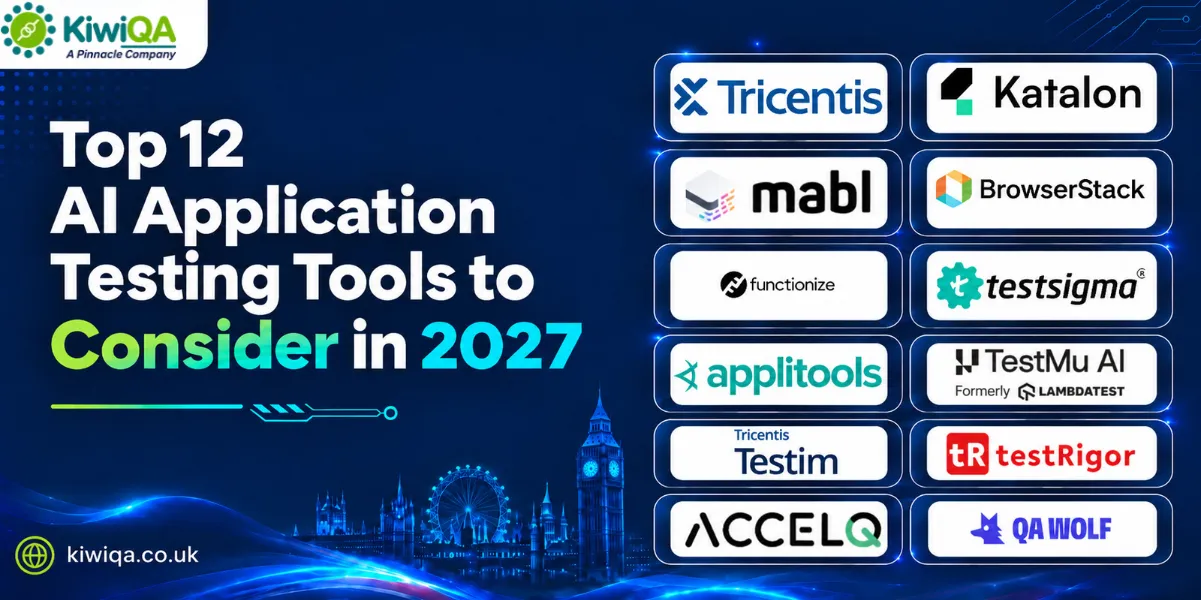
Top 12 AI Application Testing Tools to Consider in 2027
The software testing industry is changing rapidly. A few years ago, software testers mainly prioritized writing test cases, executing them manually, reporting defects, and performing regression testing. So, as businesses rely heavily on software applications, offering reliable and high-performing digital experiences has become necessary. However, frequent updates, complicated features, and shorter release cycles might make application testing more complex.
This is where AI application testing tools make a difference. They use artificial intelligence to automate test creation, execution, maintenance, and defect detection. This helps teams identify issues earlier and minimize manual effort. Partnering with an experienced AI application testing service company can further help businesses pick and implement the right testing approach.
In 2027, AI-powered testing is gaining importance as organizations aim for faster releases, greater accuracy, and consistent software quality. According to the World Quality Report 2025–26, 89% of surveyed organizations are piloting or implementing generative AI in their quality engineering workflows. Some of the most essential tools include Testim, Mabl, Functionize, Applitools, and many more. Here, you can explore 12 AI application testing tools worth considering to strengthen your software testing process.
What are AI Application Testing Tools?
AI testing tools leverage machine learning technology to enhance the overall software testing process. Such tools intelligently identify patterns and dynamically adapt and learn from each test run. They can also predict potential failures, optimize test coverage, and reduce maintenance overhead. Unlike traditional automation testing, which depends on predefined scripts and fixed rules, AI-based testing can learn from application changes while recognizing patterns.
Such top AI-powered web application testing tools can help you prioritize critical test cases and reduce repetitive maintenance tasks. By enabling intelligent test automation, they can help your development team accelerate releases while improving your test coverage.
Why Use AI for Application Testing?
AI-powered application testing can help your business improve software quality while reducing the time and effort needed for testing. With the right AI testing solutions, organizations can easily make testing more efficient, accurate, and scalable.
❏ Automate Test Creation
AI assesses application requirements, existing test data, and user behavior to create relevant test cases. This reduces manual test preparation and allows your team to cover important user scenarios faster.
❏ Improve Test Coverage
AI identifies untested application areas and suggests additional scenarios that testers might overlook. It helps detect potential defects across multiple workflows, inputs, and application conditions.
❏ Reduce Testing Time
You can easily accelerate test execution through AI by automating repetitive tasks while prioritizing critical test cases. This allows your development teams to identify issues faster and shorten release cycles.
❏ Minimize Testing Costs
Automated testing reduces repetitive manual work, saving time and resources across development cycles. Over time, reusable test scripts and lower maintenance efforts can give rise to long-term cost savings.
❏ Improve Bug Detection
AI assesses application behavior and test results to identify unusual patterns and potential defects. AI testing consulting also prioritizes issues based on their severity and impact, helping teams focus on critical bugs in the first place.
Top 12 AI Application Testing Tools
Choosing the right AI application testing tool depends on your application’s complexity, testing needs, technology stack, and development workflow. Here are the best AI application security testing tools that offer multiple capabilities.
1. Testim

Testim is an AI-powered test automation platform curated to simplify functional testing for web apps, mobile apps, and Salesforce environments. It uses ML to identify the elements of the application and create stable tests that need less maintenance when the interface changes.
➤ Key Features and Applications
• AI-powered smart locators help identify interface elements and reduce test failures caused by minimal AI changes.
• It supports reusable test components and customization through code and automated test creation.
• Integrates with development workflows to support continuous testing.
✦ Ideal Use Cases
» Businesses testing frequently updated web applications.
» Teams looking to minimize test maintenance and automate repetitive functional tests.
» Organizations testing complicated Salesforce applications.
2. Mabl

It is an AI-driven testing platform that supports complete testing across web, mobile, API, and AI-powered applications. This is considered to be one of the top AI-powered web application testing tools on the market. Its intelligent automation capabilities help teams create tests and monitor application changes.
➤ Key Features and Application
• AI-assisted test creation and maintenance.
• It supports functional, API, mobile, and regression testing.
• Offers intelligent failure analysis.
✦ Ideal Use Cases
» It can be beneficial for agile development teams releasing software.
» Businesses needing complete testing across multiple application types.
» Organizations developing AI-powered applications.
3. Functionalize

This tool uses AI and ML to simplify test creation and maintenance, along with execution. Its intelligent testing approach can help your AI consulting services for QA automate complex workflows.
➤ Key Features and Applications
• Intelligent element recognition helps tests adapt to application changes.
• AI-assisted test creation through natural-language descriptions.
• Supports automated execution and test analysis.
✦ Ideal Use Cases
» Enterprises handling complex testing environments.
» QA teams looking to automate repetitive test creation.
4. Applitools

Applitools specializes in visual AI testing. This can help your team identify interface issues that traditional functional tests might not offer. Its Eyes technology compares application screens across browsers and devices to detect unwanted visual defects.
➤ Key Features and Applications
• Visual AI identifies layout issues and unexpected UI changes.
• Supports visual regression testing, localization testing, and CI/CD integration.
✦ Ideal Use Cases
» Businesses where consistent user interface design is necessary.
» Teams testing applications across browser and device combinations.
5. Tricentis Tosca

It is an enterprise continuous testing platform curated to automate functional and complete testing across complicated environments. Its model-based approach and AI-assisted capabilities can help your team create, manage, and maintain test cases more effectively.
➤ Key Features and Applications
• Model-based test automation reduces dependence on traditional scripting.
• AI chat supports test creation and maintenance through conversational interactions.
• Offers risk-based testing.
✦ Ideal Use Cases
» Large organizations testing interconnected enterprise apps.
» Businesses using SAP and other complicated business systems.
6. ACCELQ

ACCELQ is a codeless test automation platform that uses AI to simplify the software testing lifecycle. It allows testers and business analysts to create automated tests through natural-language instructions.
➤ Key Features and Applications
• AI-powered test generation and automated test planning.
• Supports web, mobile, API, desktop, and enterprise application testing.
✦ Ideal Use Cases
» Businesses looking for codeless testing solutions.
» Teams handling multiple application environments.
7. Katalon

It is a software testing platform that combines test automation with AI-assisted capabilities. Its AI Assistant helps QA teams generate test cases, execute tests, and assess failures.
➤ Key Features and Applications
• Generates test cases from software requirements and natural-language prompts.
• AI-assisted execution and failure analysis help identify potential issues.
• Supports automated web API and desktop testing.
✦ Ideal Use Cases
» Businesses who want to simplify test creation and debugging.
» QA teams handling multiple testing activities.
8. BrowserStack

It is a cloud-based testing platform that enables development teams to test applications across multiple browsers and real devices. Its AI-powered Test Companion assists testers with test generation and failure assessment.
➤ Key Features and Application
• AI can generate test cases from requirements, user stories, and live applications.
• Creates automation scripts using frameworks like Playwright, Selenium, and Appium.
✦ Ideal Use Cases
» Teams requiring cross-browser and cross-device testing.
» Businesses developing web and mobile applications.
9. Testsigma

It is an AI-powered test automation platform that simplifies testing through natural language commands and intelligent automation. Its AI agents help generate test cases from requirements and maintain test coverage.
➤ Key Features and Applications
• AI generates test scenarios and test data from requirements.
• Identifies failed test steps and suggests corrections.
✦ Ideal Use Cases
» Businesses automating repetitive regression tests.
» Teams with limited coding expertise.
» Organizations seeking faster test creation and maintenance.
10. KaneAI by Lambda Test

This is one of the best tools that most AI testing consulting services use. It helps teams plan, execute, and maintain complete tests using natural-language instructions, while reducing dependence on manual scripting.
➤ Key Features and Applications
• It supports UI, API, database, mobile, and accessibility testing.
• Generates test scenarios from documents and prompts.
• Self-healing capabilities help handle changes in application elements.
✦ Ideal Use Cases
» Organizations managing complicated web and mobile applications.
» Development teams adopting generative AI for testing.
11. testRigor

This platform allows users to create test cases through plain English instead of complicated programming scripts. It focuses on simplifying complete testing while reducing the maintenance related to traditional automation.
➤ Key Features and Applications
• It supports web, mobile, desktop, API, and regression testing.
• Creates test cases using plain-English instructions and generative AI.
✦ Ideal Use Cases
» Businesses testing applications across multiple platforms.
» Nontechnical QA professionals.
12. QA Wolf

QA Wolf is a complete testing platform that combines AI agents, automation infrastructure, and expert support to help businesses build and maintain reliable test suites.
➤ Key Features and Applications
• AI testing service provider can help with test creation, execution, and maintenance.
• Supports web, iOS, Android, and Windows application testing.
• Offers parallel test execution and CI/CD integrations.
✦ Ideal Use Cases
» Businesses requiring extensive test coverage.
» Development teams releasing application updates frequently.
» Organizations looking to scale automated testing.
Key Factors for Evaluating AI Application Testing Tools
Here are the features that you need to look for when opting for the best AI testing services and tools.
➦ AI-Powered Test Generation
Prefer tools that automatically generate test cases and support natural-language instructions to simplify test creation.
➦ Self-Healing Automation
Consider tools that automatically adjust test scripts when application elements change while reducing manual maintenance.
➦ Visual Testing
Prefer visual testing capabilities that compare screenshots and identify unexpected UI changes, layout issues, and visual defects.
➦ Cross-Browser Testing
Prefer tools that test applications across different browsers, operating systems, and devices to ensure a consistent user experience.
➦ Test Reporting and Analytics
Look for detailed execution reports and AI-based analytics that identify defects.
Challenges of AI Application Testing
Here are the challenges you might face during AI application testing.
• AI might generate irrelevant or incomplete test cases, requiring manual review and validation.
• Adopting AI testing tools might include major upfront investments in software, infrastructure, and training.
• Connecting AI tools with existing systems and workflows might generate compatibility and configuration challenges.
• AI testing might include sensitive application data, making secure data handling and regulatory compliance important for AI testing service provider.
Future of AI Application Testing
Here are the futuristic approaches you might get with AI application testing.
» Generative AI will increasingly automate test creation, scenario generation, and testing documentation.
» AI agents can easily plan, execute, and assess tests with minimal human intervention.
» Advanced AI will automatically adapt test scripts to application changes, reducing maintenance efforts.
» AI will assess historical testing data to predict potential defects and identify high-risk application areas.

Ready to Improve Your Application Testing Process?
Adopting the right AI testing solutions can assist your business in improving application quality, minimizing defects, and accelerating releases. Evaluate your existing testing processes and prefer scalable tools that match your needs. Working with experienced software testing professionals can make your implementation easy while offering better results. Partner with the best services to strengthen your application testing process.
Key-Takeaways
- AI-Powered Testing: AI testing tools automate repetitive tasks, improve testing efficiency, and reduce manual effort.
- Leading AI Testing Tools: Testim, Mabl, Functionize, and Applitools offer AI-powered software testing capabilities.
- Essential Testing Features: Intelligent test automation, self-healing capabilities, visual testing, and seamless integrations are important considerations.
- Tool Selection Criteria: Evaluate scalability, pricing, ease of use, and compatibility with existing testing frameworks.
- Improved Software Quality: Choosing the right AI application testing tool can enhance test coverage, reduce errors, and accelerate software releases.









Comments are closed.