

 by niranjan.limbachiya@kiwiqa.com
Summarize this blog post with:


Quick Summary
QA outsourcing enables businesses to improve software quality, reduce testing costs, and access specialised expertise without building a large in-house team. It offers flexible resources, advanced testing tools, faster feedback, and better support for reliable software releases. Choosing the right QA partner helps businesses manage testing efficiently while allowing internal teams to focus on core development and growth.
- 10 Key Benefits of QA Outsourcing for Modern Businesses
- What Is QA Outsourcing?
- ➥ How Does QA Outsourcing Work?
- Why Are Modern Businesses Choosing QA Outsourcing?
- 10 Key Benefits of QA Outsourcing for Modern Businesses
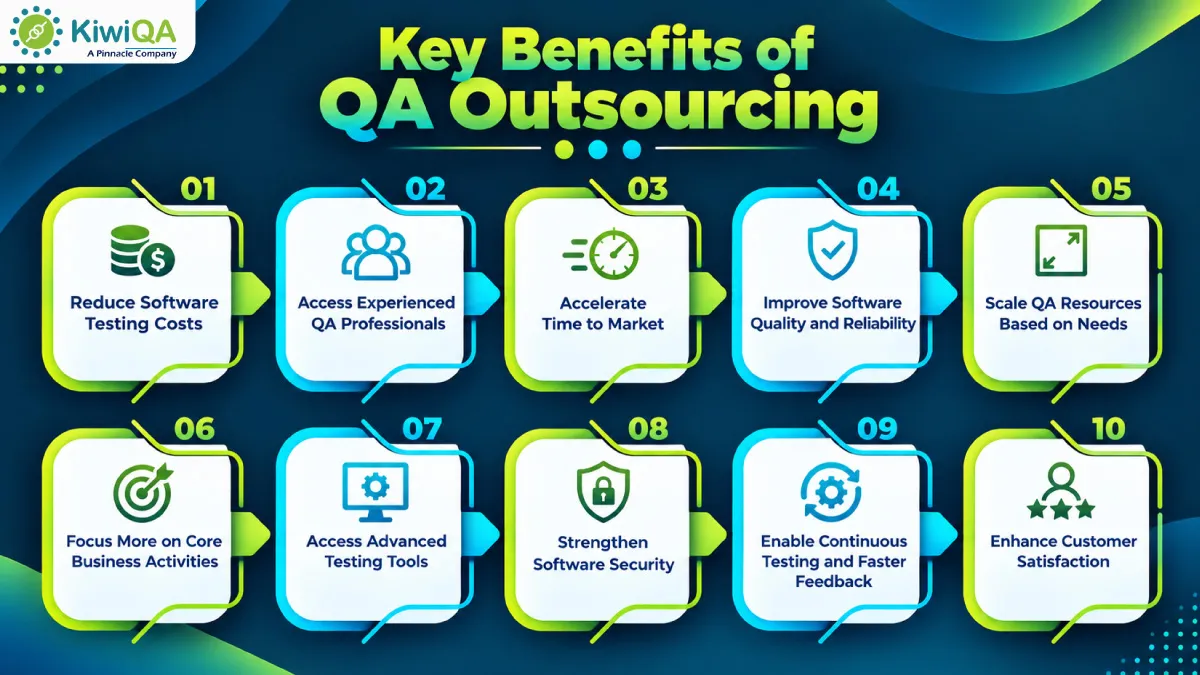
- 1. Reduce Software Testing Costs
- 2. Access Experienced QA Professionals
- 3. Accelerate Time to Market
- 4. Improve Software Quality and Reliability
- 5. Scale QA Resources Based on Business Needs
- 6. Focus More on Core Business Activities
- 7. Access Advanced Testing Tools and Technologies
- 8. Strengthen Software Security and Compliance
- 9. Enable Continuous Testing and Faster Feedback
- 10. Enhance Customer Satisfaction and Business Growth
- How to Choose the Right QA Outsourcing Partner
- ❏ Review Testing Tools and Methodologies
- ❏ Evaluate Technical Expertise
- ❏ Check Communication and Reporting
- ❏ Compare Pricing and Engagement Models
- ❏ Review Case Studies and Testimonials
- In-House QA vs. QA Outsourcing: Which Is Better?
- ✦ When Should You Choose In-House QA?
- ✦ When Should You Choose QA Outsourcing?
- Ready to Outsource QA? Let’s Build Better Software Together
10 Key Benefits of QA Outsourcing for Modern Businesses
QA outsourcing enables businesses to test software, identify defects early, and deliver reliable products without maintaining a large in-house testing team. Companies gain access to skilled testers, specialised tools, and flexible resources to handle complex projects. According to the World Quality Report 2025–26, 89% of surveyed organisations are piloting or deploying generative AI in quality engineering, highlighting the growing importance of advanced testing capabilities.
But, with limited budgets, delays in hiring and tight release schedules, it can be harder to do this. QA outsourcing services provide a viable solution to these issues and enable internal teams to concentrate on product development. The trick is to select a partner who knows what you’re looking for, will keep your information secure, and provide clear results.
What Is QA Outsourcing?
QA outsourcing is hiring an external team for software testing and quality checking. These specialists can be doing manual testing, automation testing, performance testing, security testing or complete testing.
In-house testing provides close control, but is expensive and time consuming to manage. On the other hand, outsourced qa services provide you immediate access to overseas talent. They can use specialists on a single project or maintain a team of specialists over a period of time.
➥ How Does QA Outsourcing Work?
➜ Typically, there are five steps in the process:
» Determine What to Test: Determine what features, platforms and risks should be tested.
» Select QA partner: Check the QA outsourcing services provider’s abilities, experience, tools and security.
» Establish boundaries and define scope: establish expected outputs, timeframes, budget and how to report.
» Run tests: Testers test software, re-create bugs and report on them.
» Monitor results: Test coverage, defect trends and release readiness.
Unlike having a fully internal team, software QA outsourcing allows the businesses to tap into outside expertise without doing all of the hiring and training themselves.
Why Are Modern Businesses Choosing QA Outsourcing?
Software teams are under pressure to deliver new functionality in short time while maintaining the quality of the product. You can take the pressure off your internal team right away by having reliable qa testing services.
The World Quality Report 2025-26 found that 89% of the organisations surveyed were implementing generative AI in quality engineering. This growing interest highlights the need for testing teams with the right technical skills.
Another advantage of using QA testing services is getting access to expertise that internal teams might not have, particularly in security, automation, mobile devices, and performance testing.
10 Key Benefits of QA Outsourcing for Modern Businesses
When you outsource qa testing properly, the quality of your code skyrockets. Industry data suggests that companies can expect to save 15–70% by utilizing outside teams.
1. Reduce Software Testing Costs
Hiring an in-house QA team involves paying salaries, recruitment, training, software licences, testing infrastructure, etc. When testing varies throughout the year, these expenses can be hard to keep track of.
QA outsourcing services offer project-based, hourly and managed testing. This allows them to adjust their spending level to their actual needs.
But consider overall costs, not just the hourly rates. Onboarding, communication, test maintenance and internal management time must be taken into account
2. Access Experienced QA Professionals
Outsourcing allows companies to tap into expert personnel who are familiar with various tools, testing approaches, and development platforms. 50% of the organisations surveyed said they do not have the expertise in AI and machine learning.
Reliable QA software testing services can fill this gap by offering specialists in automation and AI-assisted testing, This allows businesses to utilize the necessary expertise without having to employ a dedicated specialist for each testing requirement.
3. Accelerate Time to Market
Teams can detect defects early on with early testing, which means they won’t impact additional features. Automated regression testing can also verify that the current functions work correctly after code modifications.
Therefore, QA outsourcing can assist businesses in reducing testing delays and launching software with confidence. The actual improvements are dependent on the complexity of the project, test coverage and team co-ordination.
4. Improve Software Quality and Reliability
Some features may function properly on one device, browser, or OS, but not on another. These issues may get overlooked by internal teams if they are only concentrating on familiar user journeys.
Independent testers start with a fresh perspective and test different scenarios. Good QA testing services may span functional behaviour, usability, compatibility and even performance.
A systematic testing approach also enables teams to identify common bugs and avoid them in subsequent releases. However, testing minimises risks, it does not ensure defect free software.
5. Scale QA Resources Based on Business Needs
Demand for testing tends to spike ahead of product launches, significant updates and seasonal sales. Outsourced QA services enable companies to expand their testing team during peak demand and contract when necessary. This method prevents the hiring of people for short-term positions.
Businesses can also ask for expert assistance in case of a new platform or high-risk feature. Agreements establish the clear connection between added resources and project priorities and deadlines.
6. Focus More on Core Business Activities
Developers waste precious time testing and re-testing common work flows or researching reported problems. This work can divert their time from product development and growth.
Outsource QA testing by delegating agreed testing activities to external experts and freeing up the internal teams to concentrate on product strategy and development.
7. Access Advanced Testing Tools and Technologies
You need the appropriate tools and technical know-how to test across browsers, devices, APIs, and operating systems. Developing this in-house could require additional investment.
Some experienced providers might already be making use of automation frameworks, test management platforms and performance testing tools. They can also apply AI-assisted testing to aid in test case generation or pattern recognition.
When selecting QA outsourcing services, look at the tools that the provider uses and how they align with your development process. Discuss test ownership and maintenance, as well as licence fees.
8. Strengthen Software Security and Compliance
Software defects may compromise sensitive data or result in vulnerabilities in access controls. Regulated industries also require documentation of compliance with relevant requirements.
External experts can perform authentication, permissions, data handling and common security risk testing. They can also assist with compliance testing, if their areas of expertise align with the standards.
But, software QA outsourcing does not mean a product is secure or compliant. Before sharing sensitive information, review the provider’s data access protocols, security measures, confidentiality agreements, and certifications.
9. Enable Continuous Testing and Faster Feedback
Performing testing at the end of the development process can leave teams with a lot of defects to be resolved right before the release of the application.
When businesses outsource QA testing, external testers get to collaborate with the development team, execute regression tests, and submit defect reports via common tools. Continuous integration and continuous delivery pipelines can help to accelerate feedback.
Define priorities, reporting times and the severity of defects. This allows teams to resolve critical issues early and ensure reliable release processes.
10. Enhance Customer Satisfaction and Business Growth
Customers demand applications that are reliable, fast and secure. Broken features, slow pages, and repeated errors can damage trust.
QA software testing services can help detect issues that can impact usability and performance before release. Enhanced testing can minimize unnecessary disruptions and help facilitate a seamless customer experience.
Also Read: Key Benefits of Automation Testing for Banking Applications
How to Choose the Right QA Outsourcing Partner
Understanding the benefits of outsourcing qa testing will help you prioritize your audience. A bug-free application results in a better user experience all the way round. This consequently leads to increased customer satisfaction.
❏ Review Testing Tools and Methodologies
Ensure provider offers manual testing, automation, performance testing, and security testing as needed. Make sure that its tools integrate with your technology stack and workflow.
❏ Evaluate Technical Expertise
Check out the projects, industry experience, and specialist skills. Inquire about how your team will test your product’s riskiest attributes.
❏ Check Communication and Reporting
Choose a partner that provides clear bug reports, test results, and regular updates. Confirm working hours, escalation routes, and access to shared project tools.
❏ Compare Pricing and Engagement Models
Compare project-based, hourly, and managed testing options. Check what each price covers, including test maintenance, reporting, and changes in scope.
❏ Review Case Studies and Testimonials
Find reliable evidence of related work. If possible, communicate with previous clients and verify reliability, communication and delivery.
Also Read: List of CRM Testing Services UK Businesses Should Consider
In-House QA vs. QA Outsourcing: Which Is Better?
When comparing both models, look at the cost comparison first. In-house teams require fixed salaries, while software qa outsourcing offers flexible pricing.
In-house teams offer direct collaboration, stronger day-to-day product knowledge, and closer control over priorities. In terms of testing efficiency, specialized external teams usually work faster.
✦ When Should You Choose In-House QA?
For products that require close association and interaction with the business or for products that require a tight day-to-day control use an in-house team. Continue to test in-house for long-term internal projects, where requirements are very stable. This way, you have more process control over very sensitive data.
✦ When Should You Choose QA Outsourcing?
If your team doesn’t have the right skills, isn’t able to get tests done in time, or you need additional resources for a launch, consider outsourcing. Outsource qa testing when you do not have enough resources in your organization.

Ready to Outsource QA? Let’s Build Better Software Together
The right QA partner helps businesses manage testing costs, improve software reliability, and release products with greater confidence. It also gives internal teams more time to focus on development and business goals.
As your product and workload expands, you can rely on our QA outsourcing services to help you. Be clear about your goals, explore your options, and select a partner that places importance on clear communication, strong security and positive measurable outcomes.
Key-Takeaways
- Reduce Costs: Manage testing expenses without maintaining a large in-house team.
- Access Expertise: Gain specialised skills in automation, performance, and security testing.
- Improve Quality: Enhance software reliability, usability, and compatibility.
- Scale Flexibly: Adjust testing resources according to project demands.
- Strengthen Security: Identify vulnerabilities and support compliance testing.









Comments are closed.