
 by Mit Thakkar
Summarize this blog post with:


- Key Benefits of Automation Testing for Banking Applications
- Understanding Automation Testing in Banking Applications
- Why Businesses Should Invest in Automation Testing for Banking Apps
- ✽ Faster digital transformation
- ✽ Reduced downtime risks
- ✽ Improved compliance management
- ✽ Better customer retention
- ✽ Competitive advantage in the fintech market
- Types of Banking Applications That Benefit from Automation Testing
- ✣ Mobile Banking Apps
- ✣ Internet Banking Portals
- ✣ Payment Gateway Systems
- ✣ Core Banking Systems
- Key Benefits of Automation Testing for Banking Applications
- ✽ Faster Test Execution
- ✽ Improved Accuracy and Reduced Human Errors
- ✽ Enhanced Security Testing
- ✽ Better Test Coverage
- ✽ Cost Efficiency in Long-Term Projects
- ✽ Faster Regression Testing
- ✽ Improved Customer Experience
- Best Practices for Automation Testing in Banking
- ✣ Prioritize High-Risk Test Cases
- ✣ Implement Continuous Testing
- ✣ Use Realistic Test Data
- ✣ Regularly Update Test Scripts
- Future Trends in Banking Automation Testing
- ✽ AI-Powered Test Automation
- ✽ Cloud-Based Testing Environments
- ✽ Shift-Left Testing Approach
- ✽ Robotic Process Automation (RPA) in Banking QA
- Ready to Improve Banking App Quality with Automation Testing?
Key Benefits of Automation Testing for Banking Applications
The global banking industry has witnessed a transformation over the past few decades. The landscape is evolving from traditional establishments to advanced virtual platforms. This change has been driven by tech advancements, evolving user expectations, and the requirement for improved efficiency in financial operations. The current banking landscape manages millions of transactions every second. Customers expect real-time accessibility to their financial services, and that’s when automation testing services come in.
As the reliance on technology grows, the demand for advanced features like real-time transactions and advanced analytics also rises. These factors play a strong role in managing security, reliability, and compliance. From AI-driven chatbots to blockchain-driven transactions, the industry continues to rise. Automation testing services make efforts to offer a seamless, secure, and customized banking experience for users worldwide.
In the modern industry, the ability to process transactions at scale and manage risks in real-time makes a banking institution the real industry leader. The manual banking systems continue to be a constant hurdle for performance and visibility. As the traditional QA practices failed to match the speed, security, and reliability of modern banking apps, the banking firms require modern practices. Banking automation allows firms to execute the core workflows and offer compliance and visibility.
A report said that financial firms use AI-driven banking test automation, which limits transaction processing mistakes by 96%. Integrating automation testing drives compliance validation by 73% as compared to traditional QA practices. The comprehensive blog explores the compliance errors into competitive benefits. Read the proven methodologies and upcoming trends that automation testing companies must follow to maintain the highest security standards.
Understanding Automation Testing in Banking Applications
Banking automation is leveraged with the software & AI-based technologies such as AI, ML, and RPA. It also includes system integration, smart documentation, and BPM systems. Banking automation is used to automate & co-ordinate routine manual tasks across banking apps. The banking app supports processes like user onboarding, payment & transaction management, customer service, and risk management.
By executing automation practices, banks can enhance efficiency, limit operational errors, and scale operations across enterprises while maintaining control. Banking automation refers to the use of technologies and operations to smooth and coordinate rule-based processes across financial ecosystems. Automation testing in banking is used for limiting operational errors, strengthening regulatory rules, and enhancing scalability and consistency.
The areas where banking automation QA is required are user onboarding, loan processing, error detection, account maintenance, and customer service. Automated software testing services in banking support the redesigning and optimization of core operations across systems. It standardizes execution and scale operation without hampering compliance.
Manual testing of banking apps includes a manual tester inspecting features such as account login, fund transfer, transaction history, and payment workflows without using scripts. It supports measuring usability and visual errors. Automated QA on the other side integrates scripts and QA frameworks to execute continuous test cases quickly.
Automated testing services are great for security validation, API QA, and performance checks in a banking app where compliance and reliability are crucial. Manual QA offers flexibility, whereas automation improves consistency, speed, and test coverage. Most banking institutions utilize a blend of practices to verify secure & error-free virtual banking experiences. The basic automation testing tools used in baking involve Selenium, Appium, Junit, TestNG, and JMeter.
Why Businesses Should Invest in Automation Testing for Banking Apps
✽ Faster digital transformation
Automation QA supports banking institutions to drive virtual transformation by limiting the time necessary for software validation and release. The banking firms frequently release updates for payment systems, virtual wallets, security errors, and customer features. Automated testing verifies these updates quickly without hampering app quality.
It supports frequent integration & delivery pipelines, allowing teams to release new services faster. Automation also limits repetitive manual tasks, enabling the QA team to prioritize complicated banking scenarios and innovation. The speed is necessary in modern banking, as it influences user satisfaction and firm growth.
✽ Reduced downtime risks
Banking apps must operate frequently because users rely on them for payment, transactions, and account accessibility at all times. Automation QA limits downtime errors by measuring gaps early in the SDLC before they hamper the final product. Automated testing services ensure system stability during infrastructure changes and updates.
Automated tracking also supports measuring security & performance gaps that could lead to service interruption. By limiting human errors and enhancing QA accuracy, automation QA strengthens reliability. Stable banking apps build user trust and avoid revenue loss due to unexpected errors or failed transactions.
✽ Improved compliance management
Banking apps must match the strict financial regulations, security standards, and data safety requirements. Automation QA supports firms to manage compliance by validating security controls, transaction accuracy, and audit demands consistently across releases. Automated scripts can continuously test encryption, authentication, security, and data management processes with improved accuracy.
Test automation service providers limit the risks of compliance violations and financial penalties. Automation also generates detailed test logs & reports, which help regulatory reviews and audit documentation. Financial firms benefit from a standard QA process that verifies policy adherence across various systems. Strong compliance management enhances operational transparency while safeguarding user data and managing confidence in virtual banking services.
✽ Better customer retention
User expectations in virtual banking frequently rise as users demand faster, secure, and seamless mobile experiences. Automation QA supports banking firms in enhancing user retention by validating that apps perform seamlessly across OS, network conditions, and devices. Automated QA quickly measures errors such as failed transactions, login errors, app crashes, and slow response time prior to users encountering them.
Consistent performance improves user satisfaction and trust in the banking platform. Quick bug resolution and smooth updates also limit negative user experience that may cause users to switch providers. By managing high app quality and uninterrupted services, automation QA supports long-term user loyalty and enhances brand reputation in highly competitive financial industries.
✽ Competitive advantage in the fintech market
The fintech market evolves frequently, with new virtual banking solutions and payment technologies rising. Automation QA allows firms a competitive benefit by allowing quick innovation and high software quality. Financial firms can release new features, integrate APIs, and adapt to market demands efficiently while managing app stability.
Automated QA also supports scalability, supports banking firms to manage rising transactional volumes and user activities without degrading performance. Firms that deliver a secure and reliable banking experience obtain user confidence and market credibility. Quick product release allows firms to stay ahead of competitors and respond smartly to tech trends. In the highly competitive fintech landscape, automation QA becomes a strategic investment that drives agility, growth, and success.
Types of Banking Applications That Benefit from Automation Testing
✣ Mobile Banking Apps
Because consumers rely on mobile banking apps for everyday financial tasks, they must be continuously tested. Critical operations like account management, fund transfers, balance checks, and bill payments across various mobile devices and operating systems are validated with the help of automation testing.
The test automation service providers guarantee quick transaction processing, seamless application performance, and safe user authentication. Automation helps enterprises maintain application dependability, lower downtime errors, and offer a seamless virtual experience. IT helps to enhance consumer trust and long-term engagement with banking services as mobile banking usage continues to rise.
✣ Internet Banking Portals
Banking domain automation testing is crucial for preserving performance, security, and reliability because internet banking portals handle a variety of financial services. It guarantees that banking portals operate properly during software updates or periods of high user traffic. In order to confirm correct data processing and transaction management, automation testing also facilitates database and API validation.
Banks can speed up release cycles without sacrificing application quality by minimizing manual testing. By offering consistent access to digital financial services, safe online transactions, and effective account management, robust online banking platforms raise client satisfaction.
✣ Payment Gateway Systems
Due to their handling of sensitive financial transactions and real-time payment processing, payment gateway systems necessitate rigorous automation testing. Currency conversions, payment authorization procedures, transaction correctness, and interface with banking networks or third-party payment providers are all validated by automated testing. In order to make sure payment systems can manage large transaction volumes without experiencing delays or errors, automation also facilitates API performance checks.
System dependability is enhanced by ongoing testing during periods of high usage. Automation testing lowers payment processing failures and boosts consumer confidence by detecting problems early. For digital commerce and banking processes to run smoothly, payment gateways must be reliable and secure.
✣ Core Banking Systems
Core banking systems, which handle client accounts, transactions, loans, deposits, and financial records, form the basis of banking operations. Automation testing ensures that these intricate systems function precisely and effectively on several connected platforms. Automated scripts verify database consistency, system integration across banking apps, payment services, and customer management platforms, and backend transaction processing.
Additionally, automation facilitates regression and performance testing to find flaws prior to the deployment of software upgrades. Testing precision and reliability is crucial since fundamental banking systems handle massive volumes of financial data on a daily basis. Automated testing guarantees continuous financial services, lowers operational risks, and enhances system stability. Robust testing procedures help financial firms in upholding compliance and safeguarding client data.
Key Benefits of Automation Testing for Banking Applications
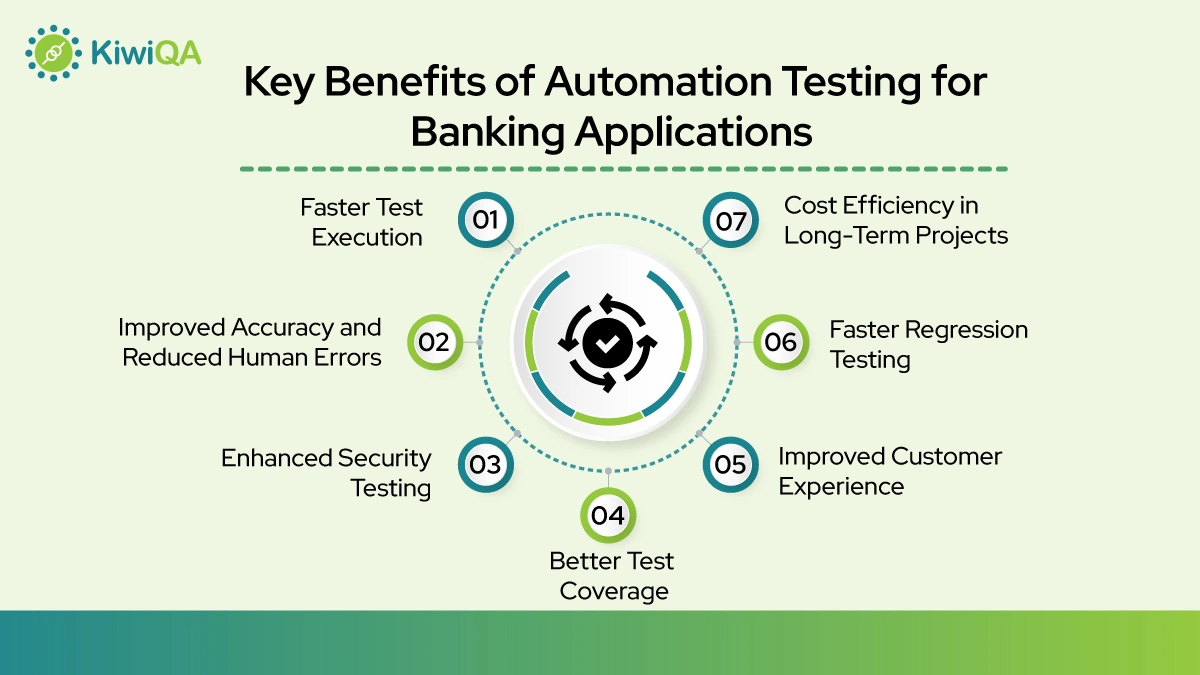
✽ Faster Test Execution
By carrying out repeated test cases far more quickly than manual testing techniques, automation testing significantly raises testing speed in banking systems. Continuous validation is necessary for account management, payment gateways, security procedures, and transactions in banking systems.
Thousands of test cases can be executed concurrently by automated scripts in several environments without any latency. This shortens software release cycles and speeds up the deployment of updates by development teams. Agile and DevOps approaches, which are commonly used in today’s banking technology environments, are also supported by faster testing.
More effectively, financial institutions can launch new digital services, mobile banking capabilities, and payment interfaces. Fast test execution increases output, reduces developmental delays, and guarantees that banking apps continue to be reliable. It satisfies customers’ increasing need for quick and seamless online experiences.
✽ Improved Accuracy and Reduced Human Errors
By regularly running pre-written test scripts without human intervention, automation testing increases accuracy. Even minor testing mistakes might result in unsuccessful transactions, inaccurate balances, or security problems in banking applications. The possibility of human error that could arise from repetitive manual testing jobs is eliminated by automated testing. Throughout each execution cycle, it guarantees that all test scenarios adhere to the same procedure and validation guidelines.
This consistency improves software dependability and facilitates more efficient defect detection. Additionally, automated technologies produce accurate results that make quality analysis and defect monitoring easier. Improved testing confidence is beneficial to banking organizations, particularly for sensitive client data management and key financial procedures. Stable banking applications and increased confidence in digital financial services are two benefits of accurate testing procedures.
✽ Enhanced Security Testing
Since banking applications handle sensitive financial data & transactions histories, security is a crucial phase. By regularly evaluating payment gateways, encryption methods, authentication systems, and access controls, automation testing enhances security validation. Automated security in the early phase of SDLC assists in identifying gaps before they become significant problems.
This proactive strategy lowers the risks associated with data breaches and security gaps. Additionally, automated API testing enhances software security. Businesses can strengthen protection for client financial data and execute solutions more rapidly by promptly identifying vulnerabilities. The efficient security testing fosters consumer trust in safe online banking services.
✽ Better Test Coverage
By validating numerous financial workflows across various platforms, devices, and operating systems, automation testing permits more extensive test coverage. Complex functions, including fund transfers, loan applications, payment processing, investment tracking, and account administration, are frequently included in banking applications. Many test cases that would be challenging and time-consuming to complete manually can be effectively carried out by automated testing.
It allows for simultaneous testing of web, mobile, API, and database components, guaranteeing that each crucial element operates as intended. Increased test coverage lowers the possibility that undetected flaws may find their way into production settings and enhances program stability. Financial organizations have greater faith in software’s ability to function under various user scenarios. In the end, thorough testing contributes to providing clients with safe, reliable, and efficient banking applications.
✽ Cost Efficiency in Long-Term Projects
For long-term banking initiatives, automation testing becomes quite cost-effective even though it involves an initial investment in tools and framework setup. Regression testing, feature updates, and system validations may all be done repeatedly with automated scripts, which lessen the need for tedious manual testing. Over time, this increases testing efficiency and reduces operating expenses.
By enabling testers to concentrate on intricate scenarios and creativity rather than monotonous duties, automation increases the efficiency of QA teams. Additionally, quicker testing cycles minimize project delays and enhance resource efficiency. Automation testing supports constant software quality while generating significant financial returns over time.
✽ Faster Regression Testing
Regression testing is crucial for banking applications since regular upgrades may unexpectedly impact already-existing features. By swiftly verifying crucial activities, including account access, money transfers, transaction history, and payment processing, following each update, automation testing expedites regression testing.
Regression suites that are automated can operate constantly without the need for human intervention, guaranteeing the stability of current features throughout new releases. This lowers the possibility of system failures in production settings and assists development teams in quickly identifying flaws. Effective regression testing guarantees that financial apps continue to operate consistently and securely while they are being developed.
✽ Improved Customer Experience
By lowering application crashes, transaction failures, and usability/performance problems, automation testing contributes to increased customer satisfaction. Automated testing guarantees that banking apps run smoothly at any time. Consistent performance validation and quicker issue detection minimize interruptions that adversely affect consumers. Automation testing directly increases customer retention and improves company reputation by providing safe, quick, and seamless digital experiences.
Best Practices for Automation Testing in Banking
✣ Prioritize High-Risk Test Cases
One of the best strategies for automation testing in the banking domain is to concentrate on high-risk regions. Because even little flaws might result in monetary losses or compliance problems, payment processing, fund transfers, and transaction workflows need to be properly tested. Using automated software testing services helps banking institutions improve testing accuracy, reduce risks, and ensure secure transaction processing across applications.
To provide safe access, authentication methods, including multi-factor authentication, OTP verification, and login, should also be given top priority. Banking organizations may lower operational risks and boost customer trust across digital banking platforms by first identifying and automating important activities.
✣ Implement Continuous Testing
Banking companies can produce safe and reliable applications more quickly with the use of continuous testing. Teams may find defects early in the development cycle and stop problems from reaching production by including automated testing in CI/CD pipelines. Rapid feature releases without sacrificing quality or compliance criteria are also made possible by continuous testing. This method guarantees that banking applications stay responsive and secure during frequent software changes and deployments. This practice is enhancing cooperation between development and quality assurance teams.
✣ Use Realistic Test Data
Validating banking apps in real-world scenarios requires the use of actual test data. Testers can find problems that might not show up with generic sample data by simulating client interactions, account activity, loan processing, and payment scenarios. Precise datasets guarantee that programs operate appropriately during high transaction volumes and enhance the dependability of functional, security, and performance testing. Before apps are made available to end users, realistic testing environments eventually improve testing accuracy and boost confidence.
✣ Regularly Update Test Scripts
For long-term testing efficacy in banking applications, automation test scripts should be updated on a regular basis. Outdated scripts may malfunction or yield erroneous results as banking platforms change due to new features, interface modifications, and regulatory changes. Script maintenance lowers false positives throughout testing cycles and ensures robust automated execution.
Teams should optimize reusable test components, eliminate unnecessary scripts, and regularly examine automation frameworks. Frequent updates also guarantee that automation initiatives continue to produce reliable QA results across evolving financial systems, enhance testing speed, and enable application scalability.
Future Trends in Banking Automation Testing
✽ AI-Powered Test Automation
AI is transforming automation QA in banking apps by making the QA process smart, quick, and effective. AI-driven testing tools are able to measure a wide range of test data, identify potential errors, and track high-risk areas before errors hamper users. Smart error assessment supports the QA team in prioritizing crucial banking tasks like payments, accounts access, and transactional processing.
Self-healing test scripts automatically adjust when app interface changes, limit maintenance efforts, and enhance QA continuity. AI also drives test optimizations by choosing the relevant test case for execution. As banking workflows are complicated, AI-based automation supports financial firms in enhancing software quality. It supports driving the release, managing a secure and reliable virtual banking experience for users.
✽ Cloud-Based Testing Environments
Cloud-driven QA environments are becoming increasingly necessary in banking automation QA because they offer flexible & scalable QA infrastructure. Financial firms can smartly create and manage various QA environments without investing much in physical hardware. Cloud-driven QA supports remote collaboration, enabling development & QA teams to test banking apps from various locations efficiently.
It also allows QA across various browsers, devices, and OS to verify consistent app performance. Scalable infrastructure support firms manage large testing workloads during peak traffic. Cloud environment enhances test execution speed, limits setup time, and lowers operational costs. As virtual banking services frequently expand globally, cloud-driven QA will play a strong role in supporting quick innovation and reliable app delivery.
✽ Shift-Left Testing Approach
The following practice is gaining popularity in banking app development since it prioritizes measuring errors earlier in SDLC. Instead of waiting for the last stage of testing, QA tasks begin with the design and coding phase. Early error detection supports banking firms in limiting costly fixes and avoiding crucial gaps from reaching production environments.
Automation testing for banking, integrated into a frequent integration pipeline, enables developers to validate code changes instantly. The following practice enhances collaboration between developers, testers, and the support team to drive software delivery. Quick feedback cycles support agile and DevOps workflows, which are used in advanced banking technology. This future trend ultimately enhances software quality, security, and the faster release of reliable banking apps.
✽ Robotic Process Automation (RPA) in Banking QA
RPA is becoming the necessary trend in banking QA because it automates continuous and rule-based workflows effectively. RPA bots can manage workflows such as transactions, data validation, and report documentation without manual intervention. In automation QA, RPA enhances operational efficiency by limiting continuous QA activities and reducing human errors.
Banking firms utilize RPA to drive the testing process for user onboarding, payment status, and compliance-driven tasks. This upcoming trend supports firms in streamlining their bank operations and enhancing accuracy in financial processes. Combined with automation QA, RPA supports a quick release cycle and improved resource utilization. As banking systems frequently evolve virtually, RPA plays a crucial role in driving QA efficiency and operational productivity.











Comments are closed.