

 by Mit Thakkar
As the reliance on SaaS apps is rising among companies, testing these apps becomes crucial. Where manual testing requires lots of labor and consists of various sets of errors, automation facilitates quick and precise testing. Modern automation tools necessitate scripting expertise, making them challenging to integrate without coding expertise. The codeless automation tool, on the other hand, is transforming this domain by delivering an accessible & intuitive approach. According to industry reports, 77% of companies have adopted automated software testing to improve efficiency and reduce errors.
SaaS apps are fundamental to modern corporate operations, influencing consumer relations & internal processes. The requirement for premium and consistent software grows along with the cloud-based solutions. To fulfill your service meets security, performance, and functionality requirements, SaaS automation testing services are performed.
Testing the SaaS domain is beyond bug detection, which covers scalability, safeguarding sensitive information & offering outstanding user experience. Whether you’re operating on an established platform or introducing a new product, testing must evolve with the increasing cloud complexities.
In today’s landscape, a single bug can impact customers’ trust and cost millions. For SaaS providers, delivering a robust, reliable platform can’t be negotiated. Automated testing services allow SaaS startups to scale testing effectively, spot errors & release quality products rapidly.
With the right automation strategy, startups can be assured that their software is stable, secure & competitive. Rapid development cycles, deployment & increasing customer expectations make it necessary to have testing in sync. QA automation testing service supports faster feedback loops, cuts down manual tasks, and improves testing accuracy. The leading SaaS companies are investing in testing services to meet the demand of a virtual-first world. Before you initiate any move, read the following blog.
What Is Automation-First Testing?
➔ Definition and Core Principles
These days, operational efficiency is a primary concern, and software delivery timelines are becoming shorter. Nowadays, businesses are adopting automation testing company. Automation-first testing is an essential component of workflow planning, design, and execution rather than an afterthought that can be used if human methods haven’t worked out or have become too routine.
Automated testing service is a strategy that allows scaling operations with little human intervention. In order to compete, innovate, and grow with confidence in a rapidly evolving technology landscape, it is imperative that organizations adopt an automation-first culture as they become more digitally mature.
Automation testing service is a method of software testing that automatically runs pre-defined test cases using tools and frameworks. The procedure involves analyzing your product or website’s performance, user interface, and functionality to make sure everything is operating as it should.
A crucial component of every software development cycle is automation testing. By detecting the errors early, businesses can save their time & resources. Additionally, it may be applied to a number of testing kinds, such as functional, regression, accessibility, acceptability, integration, and unit testing.
➔ How It Differs from Traditional Testing Approaches
• Mindset shift: Traditional testing frequently starts with manual labor and adds automation to help with repetitive work. Automation is incorporated into development workflows and given priority from the start in modern testing procedures. Continuous validation, quicker releases, and fewer human mistakes are made possible by this change. Instead of largely depending on laborious manual labor, teams concentrate on creating robust automated suites that guarantee constant quality.
• Quality approach: In traditional approaches, testing usually finds flaws after development is finished, which causes delays and reactive corrections. By integrating testing in each phase of SDLC, modern methodologies place an emphasis on proactive fault prevention. Code reviews, continuous integration, and shift-left testing are some techniques that help in the early detection of problems. Automation testing consultants guarantee faster deployment, lower rework expenses, and enhanced product stability.
• Feedback loops: Late in the development cycle, traditional testing often produces feedback, which increases the complexity and expense of fault correction. Continuous integration and deployment pipelines allow for instant validation thanks to web automation testing services. Real-time insights into the functionality and quality of the code are sent to developers, enabling prompt fixes. Quicker feedback loops promote a more responsive and agile development environment, speed up delivery schedules, and improve teamwork.
• Scalability: As the complexity and user base of applications increase, manual testing procedures may create bottlenecks. Modern automated testing frameworks by automation testing companies effectively cover a variety of environments, devices, and configurations, scaling with the growth of the product. Concurrent operation of automated suites minimizes regression cycles and preserves consistency. As features grow and release cycles increase, this scalability guarantees that quality stays the same.
Why Traditional Testing Slows SaaS Growth
➡ Manual regression testing can’t keep pace with feature velocity
Updates, integrations, and new features are regularly deployed in rapidly expanding SaaS settings. Manual testing leads to testing backlogs and raises the possibility of undetected problems. Test cases increase as the product grows, slowing down the dependability of human execution. In the end, this misalignment affects quick, confident deployments.
➡ Increased risk of production incidents and customer-facing defects
Traditional testing frequently has coverage gaps because of human limitations and time limits. Critical edge cases, integration issues, or performance bottlenecks may go unnoticed until after release. Production errors hamper user experiences, raise support expenses, and damage customer trust. SaaS businesses put themselves at greater risk for financial and brand damage if they don’t use automated and ongoing validation.
➡ Extended release cycles that delay time-to-market
Release cycles lengthen and lose predictability when testing is primarily done manually. Teams must allocate significant time for regression testing before every deployment, which slows down product rollouts. Speed is crucial in cutthroat SaaS markets, and traditional testing techniques can slow down innovation.
➡ Rising long-term QA costs as headcount scales linearly with product complexity
More QA experts from automation testing for SaaS companies are needed to ensure quality through manual testing as SaaS solutions become more complicated. Eventually, the expense of overseeing more teams, organizing testing, and managing rework surpasses the automation investment. Scaling SaaS enterprises makes traditional testing a financial burden.
➡ Team burnout: repetitive manual testing drains engineering and QA resources
QA engineers may become less motivated as a result of repetitive manual regression cycles. Reusing a similar test case again and again limits creativity and skill improvement. It lowers team productivity and raises the chance of turnover. Teams continue to execute tasks repetitively rather than strategically, which affects morale and long-term performance.
➡ Competitive disadvantage: slower iteration cycles vs. automation-enabled competitors
SaaS businesses that depend on conventional testing find it difficult to keep up with their automation-driven rivals. Competitors can adapt to client demands, offer features more rapidly, and continuously enhance the user experience via faster iteration cycles. Without automation, companies run the risk of slipping down the market positioning, customer happiness, and innovation.
Also Read: Top Automation Testing Trends Every Enterprise Should Watch in 2026
How Automation-First Testing Accelerates SaaS Scaling
⇒ Faster, More Frequent Release Cycles
Automation-first testing makes it possible to run tests in parallel. It is cutting down on regression cycles from hours to minutes and significantly speeding up delivery schedules. Continuous testing and deployment are supported by seamless CI/CD integration, which guarantees that every code change is validated immediately.
Automation testing for SaaS companies may deploy changes more regularly and with confidence when manual approval bottlenecks and repeated validation stages are removed. Implementation is further streamlined by working with an expert automation testing company. They guarantee optimized frameworks and speed-to-market gains.
⇒ Improved Product Quality at Scale
Automation-first approaches allow for early defect discovery prior to code going into production by integrating quality into every phase of development. Consistent validation across products, integrations, and intricate user routes is ensured via thorough, repeatable test coverage. SaaS businesses that implement proactive quality assurance procedures produce reliable, effective products that increase client satisfaction and foster trust on a large scale.
⇒ Cost Efficiency and ROI Over Time
When compared to manual procedures, automated testing drastically reduces the cost per test execution. By reducing reliance on repetitive, low-value manual tasks, organizations optimize QA resource utilization. Automation testing for SaaS consultants can concentrate on strategic validation initiatives, edge cases, and exploratory testing. Investments in automation offer a high return on investment over time.
⇒ Confidence to Scale Features, Teams, and Markets
Teams can safely expand features without worrying about damaging existing functionality when there is strong automated test coverage. Automated tests serve to speed up the onboarding process for new developers. Collaboration and responsibility are promoted when product, engineering, and QA all share quality ownership.
Essential Test Types in an Automation-First Strategy
➱ Unit Tests
Unit tests verify that each code operates as assumed by validating distinct parts, features, or modules separately. Developers can swiftly spot problems at the very beginning of development. Defect detection at this lowest-cost step strengthens the entire codebase, minimizes rework, and makes debugging easier. A solid foundation of unit tests enhances code stability and speeds up feature development in an automation-first approach.
➱ API and Integration Tests
The accurate communication and data integrity of various services, databases, and third-party systems are confirmed via API and integration testing. These testing SaaS applications are essential for guaranteeing backend stability for SaaS platforms that are based on microservice architectures.
Without depending entirely on the user interface, they verify service dependencies, error handling, authentication flows, and business logic. Early in the pipeline, automated API testing assists in identifying contract inconsistencies and integration issues. Organizations can enhance system resilience, avoid cascade failures, and sustain consistent performance in intricate distributed systems by regularly verifying service interactions.
➱ UI and End-to-End (E2E) Tests
End-to-end (E2E) and user interface (UI) tests replicate actual user processes throughout the program, from login to transaction completion. The smooth operation of front-end interfaces, backend systems, and interconnections is confirmed by these tests. Teams make sure that important features work as expected before releasing them by automating crucial user journeys and business-critical paths. E2E automation offers great confidence in system behavior, despite the fact that it is usually slower than unit or API tests. Carefully considered E2E coverage lowers production faults and protects the user experience while the program develops in an automation-first approach.
➱ Performance and Load Tests
Tests of performance and load determine how the program responds to different traffic volumes, data volumes, and concurrent users. The automation testing for SaaS solution verifies the scalability, stability, and responsiveness of the system in situations of growth or high utilization. Teams can find bottlenecks, memory leaks, or infrastructure limits before they affect consumers by modeling real-world workloads. As features are added, the platform’s reaction times are kept within reasonable bounds thanks to ongoing performance testing. Proactive load validation avoids outages, slowdowns, and poor user experiences in SaaS environments, which would otherwise impede long-term growth.
➱ Security Tests
As the platform grows, security testing guarantees adherence to industry regulations & saves user’s data. Vulnerabilities, including configuration errors, unsafe dependencies, and authentication problems, are found by automated security scanning. Continuous vulnerability detection with each code update is made possible by integrating these tests into CI/CD pipelines. By strengthening defenses prior to deployment, this shift-left strategy lowers the possibility of expensive breaches. Proactive security validation in an automation-first approach promotes regulatory compliance, long-term SaaS growth, and consumer trust.
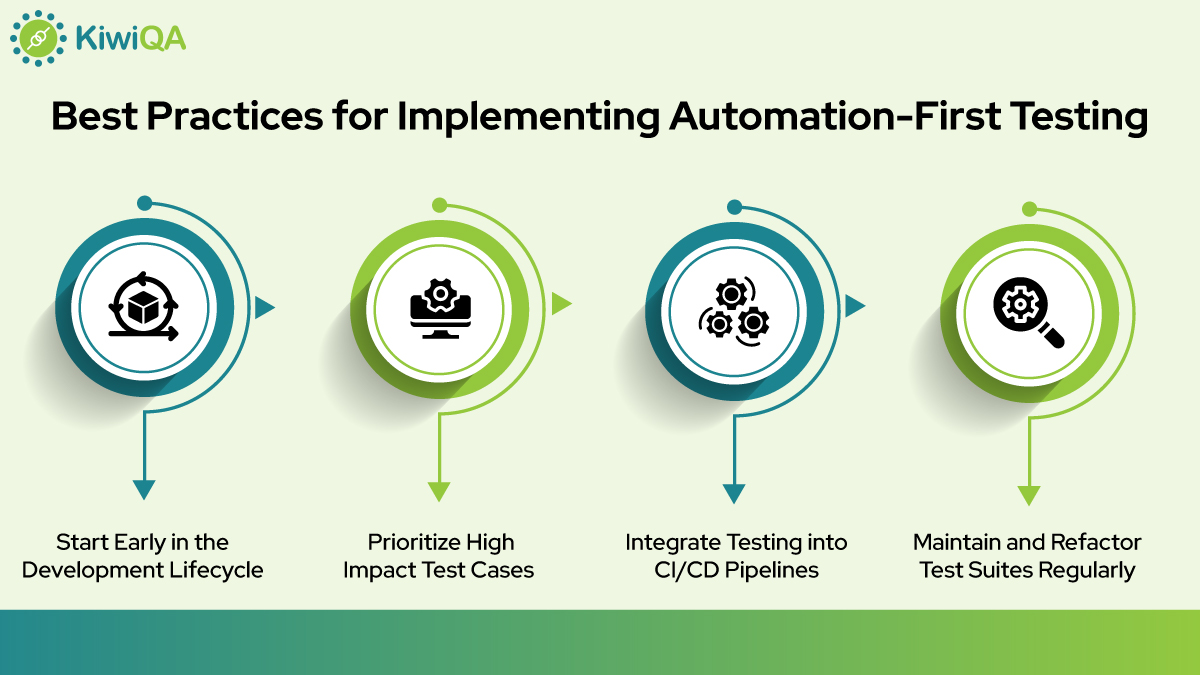
Best Practices for Implementing Automation-First Testing
1. Start Early in the Development Lifecycle
Shift-left testing methodology guarantees that quality is taken into consideration from the initial phase. To establish acceptance criteria and possible edge cases, teams from the product, engineering, and QA departments should work together right away. TDD covers test creation before or alongside code, improves design clarity, and lowers defects. Rework is reduced, feedback loops are accelerated, and a solid basis for scalable, superior SaaS service is established through early automation integration.
2. Prioritize High-Impact Test Cases
Since not all test cases are equally valuable, automation initiatives should start with features that have a significant influence on revenue and important user journeys. To maximize return on investment, complicated workflows, regularly updated components, and regression-prone modules should be automated early. Effective resource allocation and test coverage decisions are supported by the use of risk-based prioritization. Instead of just increasing the number of tests, this deliberate strategy guarantees that automation has a quantifiable commercial effect.
3. Integrate Testing into CI/CD Pipelines
Integrating automated testing into CI/CD workflows guarantees that each pull request and code contribution initiates validation immediately. This gives developers timely, actionable feedback so that errors can be resolved prior to turning complicated. When crucial tests are unsuccessful, automated gates can stop deployments, keeping unstable versions out of production. The delivery pipeline’s ongoing testing improves release confidence, lowers production problems, and facilitates dependable, quick SaaS growth.
4. Maintain and Refactor Test Suites Regularly
Automation requires ongoing maintenance and improvement; it is not a one-time setup. Removing faulty tests is crucial to maintaining confidence in automated results. Test code should be handled with the same rigor as production code, and tests should change as the product does. Hiring automation testing experts helps in creating best practices and scalable, maintainable frameworks. Working with automation testing consultants guarantees consistency, flexibility, and long-term quality improvement.
Common Challenges and How to Overcome Them
• Challenge 1: Initial Setup Time and Tooling Decisions
Choosing tools, frameworks, and setting up pipelines all demand upfront investment in automation-first testing. Delivery may be slowed by this initial setup, which can feel overwhelming. To get around this, automate high-impact, high-risk test cases first, then progressively increase coverage.
Using well-established frameworks like Playwright, Cypress, or Selenium guarantees community support and cuts down on experimentation time. Teams can create a solid foundation without interfering with ongoing releases by using clear architecture planning and phased implementation, which makes the shift to automation organized and long-lasting.
• Challenge 2: Skill Gaps Within Teams
The proper technical know-how is essential for automation success. Mostly, teams start off with weak scripting, framework design, or CI/CD integration abilities. Automation attempts could slow or result in unreliable tests if the right information is not available. To upskill engineers, organizations should spend money on internal documentation, a structured training program, and knowledge sharing across teams.
Capabilities are further strengthened by code reviews and pair programming. Collaborating with outside specialists or consultants can also help organizations develop best practices and expedite capability building. It helps to move toward scalable, maintainable automation strategies.
• Challenge 3: Test Maintenance Overhead
Automated tests that are poorly designed might become fragile and challenging to maintain as applications change. Trust in the automation suite is damaged by frequent failures due to minor UI errors. Teams should create modular, reusable, and well-structured tests from the beginning to save maintenance overhead.
Taking complete ownership with accountability for test quality ensures consistent upkeep. Long-term automation effectiveness is ensured by routinely reworking the test script. It helps to keep the suite streamlined and current with product developments.
• Challenge 4: Balancing Speed with Coverage
Feedback may be delayed, and execution duration may be increased if all tests are run on each commit. Teams should use accurate test suites and deeper regression suites for greater assurance. Efficiency is ensured by optimizing execution through selective test runs, environment scalability, and parallelization. This SaaS automated testing strategy preserves the quick iteration needed for SaaS expansion while maintaining high release confidence.
Also Read: A Complete List of Automation Testing Services for Enterprises
Real-World Impact: How SaaS Companies Benefit from Automation-First Testing
Faster time-to-market: Automation-first testing eliminates time-consuming manual regression processes, significantly reducing release cycles. Teams may release updates on a weekly or even daily basis with confidence when CI/CD pipelines incorporate continuous validation. Quicker time-to-market enables SaaS organizations to react swiftly to market changes, consumer feedback, and competitive challenges.
Improved customer satisfaction: Regular automated testing lowers user-annoying performance problems, downtime, and defects. Users are more likely to interact meaningfully with the platform when they have faith that upgrades won’t disrupt essential functionality. In highly competitive SaaS industries, reliability becomes a crucial distinction.
Reduced churn: Regular manufacturing failures can cause churn and damage consumer trust. Automated-first testing reduces these risks by identifying flaws prior to deployment. To guarantee a smooth user experience, proactive validation of key workflows, integrations, and performance is necessary. Customers are therefore less disturbed, which increases lifetime customer value for SaaS companies. It strengthens customer loyalty and lowers churn rates.
Better team alignment: By integrating quality checks directly into development processes, automation promotes shared accountability among engineering, QA, and product teams. Automation testing for SaaS partners works together continually on test coverage, acceptance criteria, and release readiness rather than in discrete testing phases. This shared ownership speeds up decision-making and enhances communication.
Competitive advantage: SaaS companies that embrace automation-first testing gain a measurable competitive edge. Faster release velocity enables rapid experimentation, innovation, and feature enhancement. When the product quality is consistent, it promotes brand trust and market reputation. By combining speed with stability, automation-driven organizations outperform slower, manual-dependent competitors and position themselves as leaders in their industry.

Ready to Scale Your SaaS Without Compromising Quality?
Scaling a SaaS business overnight isn’t possible. There are so many scenarios where the product slows down, release becomes stressful, & cost rises. Strong SaaS product development is an essential element of long-term company expansion. It guarantees that your product can support ongoing innovation, maintain security and compliance, grow effectively, and provide a flawless user experience. Businesses may create a scalable SaaS foundation by adopting a digital-first mindset, maximizing customer success activities, and utilizing data-driven insights.
For a SaaS business owner, it’s a real challenge to attract customers. Performance remains predictable, and delivery remains consistent with the increasing user base. The automation-first approach to testing in SaaS acts as the guide to businesses seeking to drive their testing approaches & overall software quality. By integrating automation testing into the SDLC and balancing the manual testing efforts, the team can achieve significant improvements.
Embracing these techniques fosters quality & innovation. The automated testing services change the way organizations think about scalability, efficiency, and innovation. For the current technological environment, the automation-first approach isn’t about the future but the current necessity.
Firms that embrace these approaches receive better efficiency, agility, and competitive benefits. Partner with KiwiQA’s expert automation testing for a SaaS services provider to help build a scalable solution. The team approaches an automation-first testing strategy that delivers digital confidence as you grow.








Comments are closed.