
 by Mit Thakkar
Summarize this blog post with:


- List of AI Application Testing Services Businesses Should Know
- What Is AI Application Testing?
- Why Do Businesses Need AI Application Testing Services?
- ✦ Improve AI Model Accuracy
- ✦ Reduce Business and Operational Risks
- ✦ Maintain Data Quality
- ✦ Improve Security and Compliance
- ✦ Deliver Better User Experiences
- List of AI Application Testing Services Businesses Should Know
- 1. AI Model Testing and Validation
- 2. Machine Learning Model Testing
- 3. AI Functional Testing
- 4. AI Data Testing
- 5. AI Bias and Fairness Testing
- 6. Generative AI Application Testing
- 7. Large Language Model Testing
- 8. AI Chatbot and Virtual Assistant Testing
- 9. AI Performance Testing
- 10. AI Security Testing
- 11. AI API Testing
- 12. AI Integration Testing
- 13. AI Regression Testing
- 14. AI Explainability and Transparency Testing
- 15. AI Compliance Testing
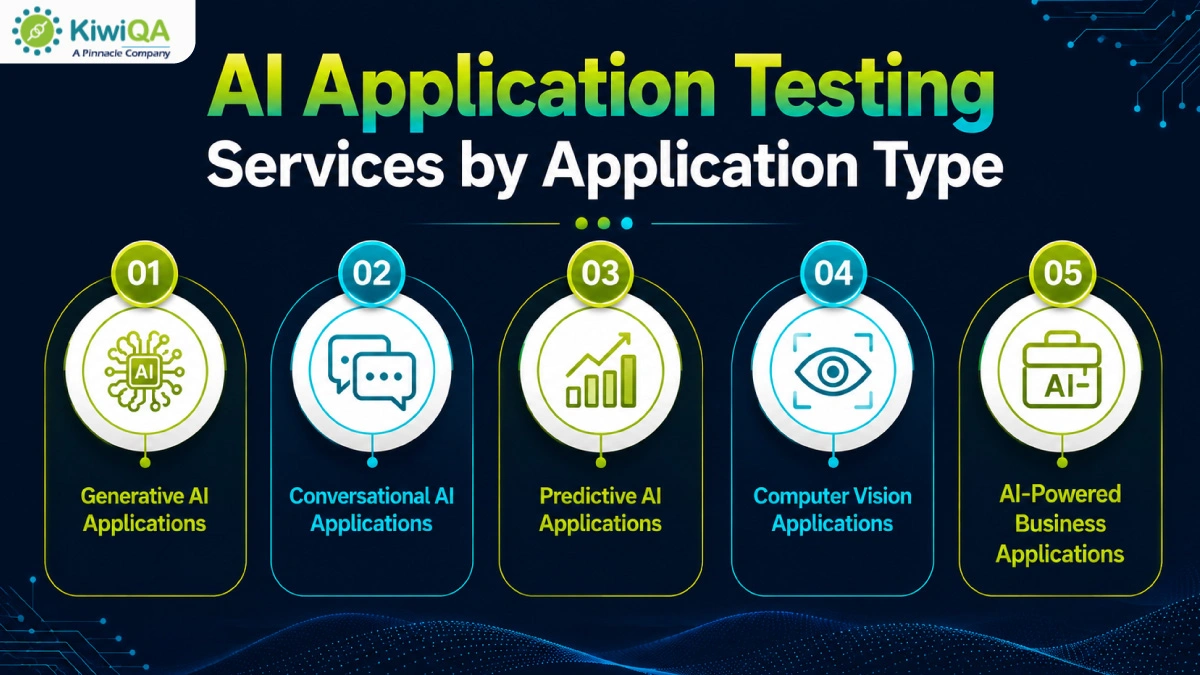
- AI Application Testing Services by Application Type
- ◆ Generative AI Applications
- ◆ Conversational AI Applications
- ◆ Predictive AI Applications
- ◆ Computer Vision Applications
- ◆ AI-Powered Business Applications
- Key Challenges in AI Application Testing
- ✦ Unpredictable AI Outputs
- ✦ Large and Complex Datasets
- ✦ AI Model Drift
- ✦ Bias and Ethical Risks
- ✦ Rapidly Changing AI Models
- What to Look for in an AI Application Testing Company
- ◆ AI and Machine Learning Testing Expertise
- ◆ Generative AI and LLM Testing Capabilities
- ◆ Strong Automation Testing Capabilities
- ◆ Security and Compliance Expertise
- ◆ Industry-Specific Testing Experience
- Build Reliable AI Applications with the Right Testing Strategy
List of AI Application Testing Services Businesses Should Know
AI-driven apps are increasingly being used across healthcare, finance, retail, customer service, manufacturing, and other business functions. As firms adopt AI for prediction, automation, content generation, recommendations, and decision-making, ensuring these apps work as intended becomes important.
Traditional software QA alone might not be sufficient because AI systems can produce variable outputs, rely mostly on data, and change their behavior as models and datasets change. The worldwide AI testing market is expected to reach USD 1.21 billion in 2026 and is expected to reach USD 4.64 billion by 2034.
AI testing services address the complexities by testing AI models, data, algorithms, APIs, integration, and app functionality across various conditions. Testing helps identify inaccurate predictions, inconsistent outputs, performance gaps, security and data quality errors before and after deployment. Frequent evaluation is also necessary as AI apps evolve over time. An effective AI testing services approach helps firms improve their accuracy, security, and user trust while supporting predictable AI-driven outcomes.
What Is AI Application Testing?
AI application testing is the method of determining AI-powered apps to validate accuracy, reliability, security, and expected behavior. Unlike traditional software testing, which checks pre-defined outputs, AI testing consulting determines model behavior, data quality, and variable outputs. It covers AI models, datasets, algorithms, APIs, integration, and app functionality. Frequent QA is necessary throughout the AI app lifecycle because changing data, models, and user behavior can impact performance and accuracy.
Why Do Businesses Need AI Application Testing Services?
✦ Improve AI Model Accuracy
AI testing solutions help organizations evaluate reliability, accuracy, and suitability for intended business applications by validating model predictions, identifying inconsistent outputs, and measuring performance across various inputs.
✦ Reduce Business and Operational Risks
By finding flaws in AI models, workflows, integrations, and system behavior, testing minimizes incorrect automated decisions, finds failures prior to deployment, and improves application reliability.
✦ Maintain Data Quality
AI testing finds data drift that can impact model performance and prediction reliability over time, validates training and testing datasets, and finds incomplete data.
✦ Improve Security and Compliance
By evaluating security risks, data protection measures, access controls, and appropriate compliance requirements, testing finds vulnerabilities unique to AI, validates privacy controls, and supports regulatory requirements.
✦ Deliver Better User Experiences
AI consulting services for QA help applications provide more accurate, consistent, and relevant experiences across various user interactions by evaluating responses, validating application behavior, and reducing unexpected outputs.
Also Read: List of AI Testing Tools for Generative AI Application Testing
List of AI Application Testing Services Businesses Should Know
1. AI Model Testing and Validation
An AI model’s accuracy and consistency are evaluated through testing and validation. To evaluate predictive performance, it incorporates model accuracy testing, precision, recall, and F1-score validation. Prediction consistency and model robustness under various circumstances can also be evaluated by an AI testing service provider. While model performance benchmarking evaluates results against predetermined standards, false positive and false negative analysis helps in identifying incorrect classifications.
2. Machine Learning Model Testing
ML model testing evaluates how well ML models function in training, validation, and production settings. While test dataset validation evaluates the model’s performance on untested data, training model validation focuses on how well the model learns from available data.
Regression testing for machine learning models, classification model testing, and model behavior testing under various inputs are examples of testing. Additionally, data processing, model training, evaluation, and deployment stages are checked for consistency and expected functionality during ML pipeline validation.
3. AI Functional Testing
AI functional testing establishes whether an AI application correctly carries out its specified features and business operations. While business logic validation examines whether decisions and outputs adhere to predetermined guidelines, feature-level testing confirms individual AI capabilities.
End-to-end AI workflow testing assesses every phase of the process. Validation of input and output verifies data processing and produced outcomes. While regression testing ensures that application updates have not impacted previously functional AI functionality, integration testing verifies interactions with linked systems.
4. AI Data Testing
AI data testing focuses on accuracy and consistency of the data that an AI application generates. At the same time, data accuracy validation verifies that values accurately reflect the intended information, and data completeness testing finds missing necessary information. Missing data identification draws attention to values that are not available, while duplicate data detection finds duplicate records. Testing for data consistency determines whether information is consistent across sources. Validation of data transformation ensures that data is appropriately transformed as it passes through AI processing pipelines.
5. AI Bias and Fairness Testing
Testing for AI bias and fairness determines whether an AI system consistently produces different results for specific groups or demographic categories. While dataset bias testing assesses whether training data contains imbalances, algorithmic bias detection looks for potentially unfair patterns in model decisions. Validation of fairness metrics uses predetermined fairness criteria to measure results. While decision consistency testing looks for comparable outcomes in similar cases, demographic performance testing compares model behavior across groups.
6. Generative AI Application Testing
Application testing for generative AI assesses whether systems respond to user prompts with appropriate, accurate, and consistent outputs. While response accuracy validation verifies factual and task-specific accuracy, prompt-response testing focuses on how applications react to various instructions.
Testing for hallucinations reveals false or unsupported information. Testing for context retention determines whether relevant data is retained throughout interactions. While content safety testing looks for harmful, inappropriate, or policy-violating generated content, output consistency testing compares responses under comparable circumstances.
7. Large Language Model Testing
LLM testing assesses how well an LLM comprehends inputs and produces suitable responses. LLM response accuracy testing verifies that the information produced satisfies the necessary standards. While context understanding testing assesses the model’s capacity to comprehend surrounding data, prompt sensitivity testing looks at how small prompt changes impact outputs.
Response relevance testing establishes whether responses address the requested topic, while reasoning validation evaluates the quality of logical responses. Behavioral changes following model, prompt, or configuration updates are detected by LLM regression testing.
8. AI Chatbot and Virtual Assistant Testing
Testing AI chatbots and virtual assistants checks how well conversational systems comprehend users and respond appropriately during a conversation. While intent recognition testing verifies whether user requests are correctly identified, conversation flow testing assesses whether dialogues proceed as intended.
Tests of natural language comprehension evaluate how various phrases and expressions are understood. Response validation verifies the accuracy and suitability of responses. While fallback response testing confirms how the system responds to invalid requests, multi-turn conversation testing assesses context across several exchanges.
9. AI Performance Testing
An AI application’s behavior under various workloads and usage scenarios can be determined through AI performance testing. Response time testing assesses how quickly requests are processed and results are returned by the system. While stress testing assesses behavior beyond typical capacity, load testing aims to look at performance under anticipated user volumes.
Testing for scalability establishes whether performance can be sustained as demand rises. Concurrent user testing examines how the system behaves when several users use AI features at once. Performance testing of AI infrastructure assesses the use of computers, memory, networks, and related resources.
10. AI Security Testing
Vulnerabilities that could impact AI models, apps, APIs, data, or users are found through AI security testing. Potential flaws in the AI environment are assessed by AI vulnerability assessment. While model manipulation testing evaluates attempts to change or influence outputs, prompt injection testing determines whether malicious instructions can alter model behavior.
Data leakage testing determines whether private information can be revealed, while API security testing looks at exposed interfaces. Testing for authorization and authentication confirms that access is limited in accordance with established roles and permissions.
11. AI API Testing
AI API testing evaluates the accuracy, security, and consistency of application programming interfaces used by AI systems. While request and response validation examines whether data is properly structured and returned, API functionality testing confirms supported operations.
Response times and behavior under various workloads are measured through API performance testing. Testing for error handling looks at how APIs react to unsuccessful or invalid requests. While third-party AI API integration testing examines communication, data exchange, and compatibility with external AI services, authentication testing confirms access controls.
12. AI Integration Testing
AI integration testing confirms that AI programs correctly exchange data and communicate with other business systems. ERP integration testing aims at enterprise resource planning integrations, whereas CRM integration testing assesses relationships with customer relationship management systems.
Third-party application testing assesses external system connections, while cloud platform integration testing verifies communication with cloud services. Data movement between processing stages is verified through data pipeline integration testing. Testing for API and microservices integration verifies dependencies, workflow execution, and data exchange in distributed environments.
13. AI Regression Testing
AI regression testing determines whether modifications to an AI system accidentally impact model behavior or current functionality. To find unexpected performance variations, model update validation compares outcomes before and after model modifications. After software updates, application regression testing confirms current features.
Validation of dataset changes looks at the impact of updated or new data. Automated regression testing relies on repeatable test procedures to assess frequently evolving AI applications, models, datasets, and related components. AI feature regression testing verifies previously validated capabilities.
14. AI Explainability and Transparency Testing
The following testing assesses the ability to understand and interpret an AI system’s outputs. Testing for decision traceability determines if any variables influence the results. Model explainability validation evaluates how well explanations capture the behavior of the model. While transparency testing assesses the accessibility of relevant data, output reasoning checks focus on the foundation of produced results. Explainable AI validation assesses whether explanation mechanisms work as intended for stakeholders and users.
15. AI Compliance Testing
AI compliance testing assesses whether AI applications adhere to relevant organizational, regulatory, privacy, and governance requirements. Data privacy testing looks at the methods used to gather, handle, store, and safeguard sensitive and private data. While compliance control testing assesses necessary precautions, AI governance validation verifies that established governance procedures are followed.
Validation of data handling looks at access and processing procedures. While risk management validation evaluates how identified AI risks are recorded, managed, and tracked, audit readiness testing determines whether relevant evidence and documentation are available.
AI Application Testing Services by Application Type
◆ Generative AI Applications
Based on user input, generative AI applications produce texts, digital media files, and summaries. It covers AI content creation platforms, AI assistants, and generative AI enterprise applications. Output accuracy, relevance, consistency, hallucination rates, timely handling, context retention, and content safety are typical evaluation domains. For various generative AI use cases, AI testing consulting can also manage test strategy, evaluation standards, model behavior, and integration needs. Testing helps in determining whether produced outputs satisfy specified functional, quality, and safety requirements.
◆ Conversational AI Applications
Conversational AI apps can help with text- or voice-based communication while interacting with users in natural language. Chatbots, voice assistants, and customer service bots belong under this category. Intent recognition, natural language comprehension, conversation flow, response accuracy, context retention, multi-turn interactions, and fallback handling are all commonly assessed during testing.
Testing for speech recognition, pronunciation, accents, background noise, and response latency may also be necessary for voice assistants. Conversational systems’ ability to comprehend user requests and respond appropriately in a variety of interaction scenarios is confirmed through testing.
◆ Predictive AI Applications
Predictive AI apps make predictions about future events, behaviors, or risks based on past and present data. Recommendation systems, risk prediction systems, and forecasting applications are typical examples. Prediction accuracy, model performance, data quality, consistency, false positives and negatives, and behavior under various input conditions are all assessed through testing.
While recommendation systems can be evaluated for relevance and ranking quality, forecasting applications may need to evaluate prediction error. Further testing for threshold accuracy, bias, and decision consistency may be necessary for risk prediction systems.
◆ Computer Vision Applications
In order to identify objects, people, patterns, or characteristics, computer vision applications analyze images, videos, or other visual data. Object detection systems, facial recognition, and image recognition are common applications. Testing assesses performance under various image conditions, false positives, false negatives, recognition accuracy, and detection precision. Image quality, camera angles, backgrounds, and other environmental factors may also be taken into account during testing. Further assessment of facial recognition systems could focus on matching accuracy and demographic performance.
◆ AI-Powered Business Applications
In order to facilitate analysis, automation, recommendations, or decision-making, AI-powered business applications incorporate artificial intelligence into enterprise systems. AI-powered ERP systems and intelligent automation platforms are the best use cases. In addition to business workflows, data processing, integrations, permissions, and output accuracy, testing assesses AI functionality. Functional, integration, regression, performance, security, and data testing are a few examples. Additionally, testing checks how well AI-generated predictions follow established business rules and expected enterprise procedures.
Key Challenges in AI Application Testing
✦ Unpredictable AI Outputs
AI systems can produce non-deterministic responses. Expected-result testing may be challenging if similar inputs produce different results. Instead of depending only on predetermined expected responses, testers frequently require evaluation criteria based on relevance, accuracy, and consistency.
✦ Large and Complex Datasets
Large datasets with significant differences in volume, structure, and quality are frequently processed by AI applications. Testing can become resource-intensive due to high data volume, and results may be impacted by data quality problems like duplicate records. Testing across various formats, sources, populations, and real-world scenarios is also necessary for data diversity.
✦ AI Model Drift
When real-world data patterns change after deployment, AI models may perform differently. Predictions may become less accurate if real-world data changes and the information used to train the model differs. Over time, this model drift may cause the model’s performance to deteriorate, requiring ongoing monitoring.
✦ Bias and Ethical Risks
AI systems have the ability to replicate bias that is introduced through model design or found in training datasets. Algorithmic bias can influence model results, whereas incomplete or unbalanced data can lead to dataset bias. Fairness evaluation and demographic performance testing are crucial components of AI testing because these problems may result in biased automated decisions.
✦ Rapidly Changing AI Models
Regular updates to models, APIs, and supporting technologies may be necessary for AI applications. While modifying APIs may have an impact on integrations and functionality, frequent model updates could affect application behavior or output quality. Regression testing, compatibility checks, and performance evaluation are necessary before changes are implemented because new model versions may introduce unanticipated differences.
Also Read: Top 10 AI Testing Company in UK for Trusted AI Quality Assurance
What to Look for in an AI Application Testing Company
◆ AI and Machine Learning Testing Expertise
Experience testing AI/ML applications in various use cases and environments is essential for an AI application testing company. The QA team must be aware of modern AI architectures, such as cloud-based AI components, data workflows, machine learning pipelines, and APIs. Testers can find problems with models, applications, data, infrastructure, and integrations with their experience.
◆ Generative AI and LLM Testing Capabilities
Proficiency in prompt testing, LLM evaluation frameworks, and safety testing is necessary for generative AI testing solutions. A skilled AI application testing service company should be able to handle context handling, accuracy, relevance, and consistency of responses. The systematic evaluation of generative AI applications across various prompts, models, use cases, and deployment environments should be supported by AI testing solutions.
◆ Strong Automation Testing Capabilities
Effective AI application testing service is made possible by strong automation capabilities. Check frameworks for automated AI testing that can assess models, workflows, APIs, and application functionality. While continuous testing helps in identifying regressions and performance changes as models, datasets, applications, and configurations change, CI/CD integration enables testing to occur as part of development pipelines.
◆ Security and Compliance Expertise
Both application security and the need to manage sensitive data should be covered in AI testing. The AI application testing service companies must have knowledge in AI security testing, data privacy validation, and compliance testing. For regulated AI applications, familiarity with relevant organizational and regulatory requirements is also crucial.
◆ Industry-Specific Testing Experience
Experience with domain-specific testing is valuable because AI applications function differently across industries. The AI application testing service company must have knowledge in healthcare, banking and financial services, retail, SaaS, manufacturing, and telecommunications. When assessing AI applications and their outputs, industry knowledge helps testers comprehend sector-specific workflows, data requirements, and business rules.
Build Reliable AI Applications with the Right Testing Strategy
Comprehensive AI testing is necessary for building reliable, accurate, secure, and trustworthy AI apps. Firms must determine models, training, integration, APIs, security, system performance, and user interactions to address potential gaps across the app lifecycle. The AI application testing service company supports defining appropriate QA methods depending on the app’s technology, firm goals, and risk profile.
However, QA shouldn’t end after deployment. Continuous AI testing supports addressing changes in model behavior, performance, security risks, and unexpected results. Adoption of an ongoing QA strategy allows firms to identify issues earlier, maintain app quality, and support reliable AI performance as the system evolves.










Comments are closed.