
 by Mit Thakkar
Summarize this blog post with:


- List of AI Testing Tools for Generative AI Application Testing
- What Is Generative AI Application Testing?
- ✤ Why Testing Differs from Traditional Software Testing
- ✤ Common Challenges in Evaluating LLM-Powered Applications
- Why AI Testing Tools Are Essential
- ✤ Ensuring Response Quality and Accuracy
- ✤ Detecting Hallucinations
- ✤ Measuring Safety and Compliance
- ✤ Monitoring Model Performance Over Time
- ✤ Automating Regression Testing
- Top AI Testing Tools for Generative AI Application Testing
- 1. LangSmith
- 2. Arize Phoenix
- 3. DeepEval
- 4. Promptfoo
- 5. Galileo
- 6. Giskard
- 7. Humanloop
- 8. Weights & Biases (W&B)
- 9. Helicone
- 10. Prompt Security
- Benefits of Using AI Testing Tools for Generative AI Applications
- ✤ Improved Output Quality
- ✤ Enhanced Security
- ✤ Faster Development Cycles
- ✤ Better User Experience
- Best Practices for AI Application Testing
- ✤ Establish Clear Evaluation Metrics
- ✤ Automate Testing Pipelines
- ✤ Test Real-World Scenarios
- ✤ Monitor Production Systems
- How to Choose the Right AI Testing Tool
- ✤ For Startups
- ✤ For Enterprises
- ✤ For RAG Applications
- ✤ For AI Agents
- Future Trends in Generative AI Testing
- ✤ AI-Powered Automated Evaluation
- ✤ Agent Testing Frameworks
- ✤ Advanced Security Testing
- ✤ Real-Time Monitoring and Observability
- Ready to Choose the Right AI Testing Tool for Generative AI Application?
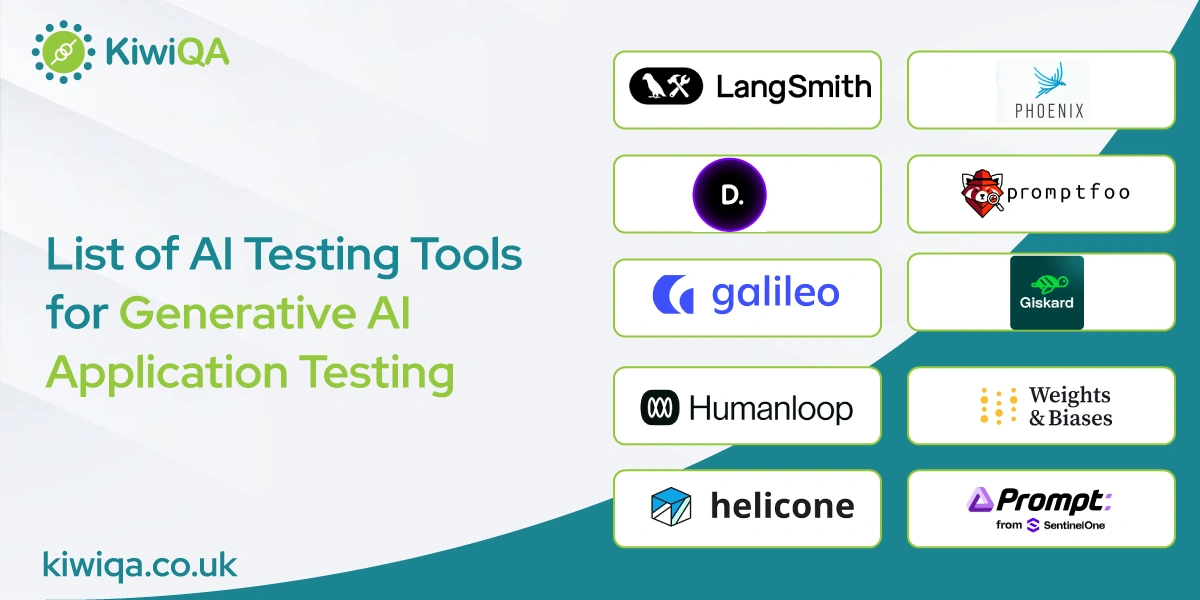
List of AI Testing Tools for Generative AI Application Testing
Generative AI is the centerpiece of a major evolution in how businesses create chatbots, AI agents, virtual assistants, and automation systems. As AI penetration continues rapidly, the need for dependable AI testing services is soaring, as companies want to make sure their AI systems produce correct, safe, and consistent outputs.
Due to the nature of content generated by large language models (LLMs), these systems are prone to hallucinations, biased outputs, and safety issues. Therefore, sophisticated AI testing methodologies become non-negotiable for enterprises. Partnering with a skilled AI testing service provider will, among other things, allow organizations to raise the bar for the quality, reliability, and performance of their AI systems.
The unpredictable nature of generative AI makes comprehensive testing essential for modern businesses. Advanced AI testing tools help detect inaccuracies, biases, and safety concerns before deployment. According to recent research 89% of companies expect to expand their use of AI technologies in software testing over the next year.
What Is Generative AI Application Testing?
Simply put, generative AI application testing is about verifying and assessing applications that are powered by AI, such as chatbots, AI assistants, recommendation systems, AI agents, and Retrieval-Augmented Generation (RAG) systems. The point is to make sure these applications provide correct, appropriate, safe, and trustworthy responses.
Formally, software testing focuses on predetermined outcomes and fixed procedures, but generative AI testing centers on assessing variable and non-deterministic responses. AI models may provide different answers to the same input, which makes problem-solving through testing harder.
➤ For example, businesses that leverage the AI testing tools list have to consider multiple aspects such as:
⮱ How accurate is the response
⮱ Whether hallucinations are detected
⮱ Risks of prompt injection
⮱ Level of bias and toxicity
⮱ Quality of retrieval
⮱ Relevance of context
⮱ Adherence to safety standards
High-tech AI testing consulting services equip companies with setting up testing plans, building evaluation frameworks, and operating continuous monitoring systems for AI applications.
✤ Why Testing Differs from Traditional Software Testing
Traditional software testing mainly revolves around verifying predetermined outputs and fixed sequences. Conversely, AI systems render interactions on the fly by leveraging training data, prompts, and user behavior.
➤ That’s what makes AI testing quite a challenge since the test teams are expected to consider:
⮱ How consistent is the output
⮱ Understanding of the context
⮱ Semantic relevance
⮱Similarity to human interaction
⮱ Safety and ethical compliance
A list of AI-based software testing tools and products equips organizations with the means for automation of such evaluations and allows the desired improvement of AI reliability.
✤ Common Challenges in Evaluating LLM-Powered Applications
➤ Generative AI poses multiple difficulties in terms of testing:
⮱ Hallucination of text generation
⮱ Unbiased or even unsafe outputs
⮱ Retrieval inaccuracies
⮱ Inconsistent outputs
⮱ Prompt injection vulnerabilities
⮱ Data leakage risk
Therefore, companies are supplementing the list of AI automated testing tools with the use of testing model behavior and application performance on a continuous basis.
Why AI Testing Tools Are Essential
AI testing tools bring a leak-proof framework for holistically putting generative AI applications under the hammer of making continuously reliable, safe, and accurate outputs, thereby enhancing overall performance and enterprise-wide AI contentment.
More and more enterprises turning to the cutting-edge AI chatbot, AI agent, virtual assistant, and Retrieval-Augmented Generation (RAG) technologies have pushed the necessity of not just initial but ongoing AI testing and monitoring through Testing Services to a substantially higher level.
Generative AI systems do not last with producing predictable outputs, thus making interaction unpredictable. That is what differentiates traditional and AI testing significantly, with the latter requiring specialized test tools for verifying output quality, security, compliance, and performance in real-time.
✤ Ensuring Response Quality and Accuracy
Organizations can rely on AI testing tools for determining whether AI-generated responses are accurate, relevant, and in line with the user’s intent. These tools help vet the correctness, consistency, and contextual relevance of AI outputs generated for various prompts and scenarios.
Enterprises resort to advanced AI testing solutions as the prime way to enhance the quality of their AI-generated content, decreasing the share of incorrect responses, and improving customer satisfaction. Ongoing evaluation also helps AI developers get to grips with the best prompt combinations and generally improve model performance over time.
✤ Detecting Hallucinations
Hallucination is a phenomenon whereby AI systems come up with false, misleading, or fabricated information that the user perceives as true. This is perhaps the most pressing issue faced when testing generative AI.
With AI testing tools, businesses are able to uncover hallucinated outputs before they reach users. Auto hallucination detection becomes a new standard for AI performance and is a major factor in the maintenance of an organization’s trust in AI-produced statements.
✤ Measuring Safety and Compliance
Businesses have to rely on AI-generated solutions that are compliant with the industry’s norms, ethics, and regulations framework. Consequently, the systems should at all times strive to refrain from generating harmful, toxic, biased, and generally unsafe responses that put the company in a position entailing legal or reputational risks.
Present-day AI testing consulting teams help firms run evaluations for the most critical safety risks, compliance issues, bias analyses, and toxicity investigations within the AI realm. If a company wants to stay responsible and secure while carrying out AI endeavors, these analyses are a must-have.
✤ Monitoring Model Performance Over Time
Changes in user behavior data combined with data updates typically lead to model performance degradation or model drift. On the other hand, model updates may also break the existing functionality. Hence, without ongoing monitoring, AI systems might start producing low-quality or unstable outputs.
AI testing tools bring along real-time monitoring, observability, and performance tracking capabilities that enable companies to not only hold but also uphold and enhance the quality as well as reliability of AI functionalities over time. What is more, continuous monitoring equips testers with actionable insights that reveal defects early on and pave the way towards long-term AI performance improvement.
✤ Automating Regression Testing
AI testing software not only fully automates regression testing for prompts, APIs, workflows, and model changes to ensure no functionality is broken during any change, but also delivers manual efforts reduction, improved test coverage, and shortened software release cycle.
This results in better change management, less time to market, and increased agility of the overall software supply chain. Furthermore, by adopting automated testing, AI development teams are better able to integrate and deploy their solutions on a continuous basis (CI/CD).
From the list of top AI consulting services for QA covering not only building & testing but also deployment & monitoring that further hold the promise of fulfilling the eventual needs to scale up AI testing whilst improving AI quality, security, compliance, and reliability of AI across enterprise systems, quite a few of them are those leading STEM-content AI testing tools.
Top AI Testing Tools for Generative AI Application Testing
1. LangSmith

➤ Key Features
LangSmith is a renowned and trusted test, debug, and monitor platform for large language model (LLM) applications created with LangChain. It enables developers and QA teams to record AI workflows, pinpoint problems, and enhance the effectiveness of generative AI applications.
Thanks to top-notch tracing and observability capabilities, the platform allows teams to follow prompts, responses, and application behavior live. Besides supporting dataset testing, workflow analysis, prompt evaluation, and performance monitoring, LangSmith also facilitates the optimization of AI systems and the reduction of response errors.
➤ Main features are:
⮱ Prompt assessment
⮱ Performance tracking
⮱ Dataset validation
⮱ Debugging workflows
⮱ Analyzing results
⮱ Best Use Cases
LangSmith mainly caters to the software-making businesses that rely on LLMs for their applications, such as chatbots, AI agents, and Retrieval-Augmented Generation (RAG) systems. With this product at hand, teams can enhance their prompt quality awareness, get deeper AI workflow insights, and keep an eye on AI application performance on an ongoing basis.
➤ The most routine tasks include:
⮱ LLM program testing
⮱ RAG pipeline evaluation
⮱ AI agent debugging
⮱ Prompt fine-tuning
Because of its leading-edge observability functionalities, LangSmith is often placed on a modish AI testing tools list for corporate-level AI applications.
2. Arize Phoenix

➤ Key Features
Arize Phoenix is a state-of-the-art AI observability and monitoring tool available as open source, which is meant for machine learning alongside generative AI purposes. With this solution at their disposal, organizations are able to follow their model efficiency, spot hallucinations, and check retrieval quality in AI systems.
One feature that stands out among the rest is the visualization of the embeddings, and it is through this feature that teams can determine what the AI model is really doing when it comes to information processing and retrieval. Alongside drift detection, Arize Phoenix also provides retrieval evaluation as well as real-time monitoring.
➤ Main strengths:
⮱ Visualizing embeddings
⮱ Identifying drift
⮱ Assessing retrieval
⮱ Detecting hallucinations
⮱ Real-time observability
➤ Best Use Cases
Arize Phoenix is a suitable choice for companies that operate production-quality AI solutions and count on continuous monitoring and observability. This is especially so for RAG systems and AI applications for which retrieval quality and response consistency are paramount.
➤ It is most frequently used for:
⮱ Monitoring performance of RAG applications
⮱ Observing LLMs
⮱ Tracking AI effectiveness
⮱ Monitoring production level AI
Due to its extensive monitoring functionalities, Arize Phoenix has become a regular member of the gen AI testing tools list.
3. DeepEval

➤ Key Features
DeepEval is an open-source evaluation program whose main focus is support for testing and benchmarking projects involving large language models. It is a fully automated evaluation solution that is designed to measure the quality of the AI-generated outputs.
DeepEval not only helps identify hallucinated responses but also assists in testing the relevancy of the answers and the detection of biases. Faithfulness checks are carried out too. Needless to say, such options have a vital impact on being able to detect and flag wrong or misleading AI-generated content as well as elevate the quality of the final product.
➤ Key features:
⮱ Detecting hallucinations
⮱ Checking the relevance of answers
⮱ Evaluating faithfulness
⮱ Finding biases
⮱ Generating automated scores
➤ Best Use Cases
DeepEval enjoys a wide application spectrum, with the most notable ones being the automation of regression testing and having AI applications benchmarked through performance evaluation. It gives QA teams the continuity essential in testing AI outputs and maintains consistent quality levels even during model changes.
➤ Most frequent uses:
⮱ Regression testing
⮱ AI quality assessment
⮱ Prompt testing
⮱ Automated benchmarking
DeepEval is now one of the front-runners in the field of AI automated testing tools for generative AI systems.
Also Read: Key Benefits of Automation Testing for Banking Applications
4. Promptfoo

➤ Key Features
Promptfoo is a prompt testing and evaluation platform that is free and open-source, focusing on helping developers make prompt comparisons and efficiently assess the outputs of large language models. It also supports scoring, automated evaluations, and regression testing.
Besides the fine-grained audit capability and making fair comparisons, the tool makes it easy to integrate with CI/CD pipelines. A bundle of features and automation that make the improvement of the prompt engineering as well as the automation of AI quality assurance processes the next level, all in one.
➤ Main features:
⮱ Prompt comparison
⮱ Regression testing
⮱ Automated evaluations
⮱ Output scoring
⮱ CI/CD integration
➤ Best Use Cases
Promptfoo would perfectly fit organizations that are focused on prompt development and automated testing workflows. Helping them with optimizing prompts, model comparison, and making the output more consistent.
➤ Eminently, it is used for:
⮱ Prompt engineering
⮱ AI workflow testing
⮱ Automated QA
⮱ Model comparison
In short, Promptfoo, for its flexibility and automation features, regularly appears on the lists of AI-driven software testing and QA tools.
5. Galileo

➤ Key Features
Galileo is an AI monitoring and evaluation platform tailor-made for the needs of generative AI applications. The platform helps enterprises measure AI performance, review prompts, and identify output quality.
Galileo offers prompt analytics, workflow analysis, hallucination detection, and AI monitoring that can be used by enterprises for the enhancement of the dependability and security aspects of their AI applications.
➤ Main features:
⮱ Prompt analytics
⮱ Hallucination detection
⮱ Response evaluation
⮱ AI monitoring
⮱ Workflow analysis
➤ Best Use Cases
Galileo is suitable for large companies dealing with the production of complex AI systems requiring continuous evaluation and monitoring. Through the toolkit, you can experiment with different prompts, and the production of high-quality AI responses can be supported.
➤ Below are common use cases:
⮱ Enterprise-level AI monitoring
⮱ LLM and AI evaluation
⮱ Prompt optimization
⮱ AI observability
Galileo is on the rise as a go-to SaaS platform in the list of top AI testing tools for software QA.
6. Giskard

➤ Key Features
Giskard is a platform that combines AI testing with governance and security validation. It supports LLM testing and helps organizations spot vulnerabilities, hallucinations, and security risks in AI programs.
The platform comes equipped with prompt injection, AI red teaming, bias detection, and hallucination checking, which helps enterprises to harden AI security and ensure ethical AI behavior.
➤ Key features:
⮱ Scanning for vulnerabilities
⮱ Detecting bias
⮱ Testing for prompt injections
⮱ Hallucination validation
⮱ Red Teaming AI
➤ Best Use Cases
Giskard provides an excellent solution to enterprises, especially those that look down on the compliance and governance aspects of AI.
This tool aids a company in identifying shortcomings in an AI system even before the deployment of such a solution is done in production, and therefore maximizes the safety and trustworthiness.
➤ Typical scenarios include:
⮱ AI security testing
⮱ LLM vulnerability testing
⮱ AI governance
⮱ Ethical AI validation
Giskard is a stalwart member of the contemporary AI testing tools lists for secure AI development.
7. Humanloop

➤ Key Features
Humanloop is a prompt management and evaluation platform that helps to develop LLM applications. It provides an opportunity for organizations to build and improve upon AI workflows using human feedback and adds an ongoing assessment process.
Some of the features it has are quick testing, version control, workflow management, and a feature for AI Evaluations. Respond to feedback loops, but make more and better use of AI to improve responses over time.
➤ Main features:
⮱ Prompt testing
⮱ Human feedback loops
⮱ Version control
⮱ AI evaluations
⮱ Workflow management
➤ Best Use Cases
In particular, Humanloop works best for organizations creating human-in-the-loop AI applications and complex prompt engineering processes. It helps facilitate a team-based approach to AI development and ongoing fine-tuning of prompts.
➤ In addition to prompt engineering, we can also help you with humanloop with:
⮱ AI workflow testing
⮱ Human-in-the-loop systems
⮱ AI optimization
Humanloop can be effortlessly incorporated into AI development workflows by those who apply AI consulting services for QA.
8. Weights & Biases (W&B)

➤ Key Features
In the machine learning and generative AI system landscape, Weights & Biases (W&B) is regarded as the facilitator of the AI observability and experiment tracking industry. It helps businesses achieve efficient management of AI performance, data handling, and comparison of AI model behaviors.
The system becomes useful for various purposes such as tracking experiments, assessing LLM performance, monitoring, and handling datasets.
➤ Main features:
⮱ Experiment tracking
⮱ LLM evaluation
⮱ Performance monitoring
⮱ Dataset management
⮱ Model comparison
➤ Best Use Cases
This is the ideal tool for machine learning teams and organizations dealing with huge infrastructure workloads of AI experiments and observability work.
➤ Typically, it is used for:
⮱ Monitoring AI models
⮱ Experiment analysis
⮱ LLM evaluation
⮱ Machine learning observability
W&B is still the dominant platform in the list of AI-based software testing tools.
9. Helicone

➤ Key Features
Helicone is a platform designed for observability of LLM applications and API interactions with emphasis on being open source. It allows companies to monitor AI usage, optimize costs, and improve the performance of their AI applications.
Logging of requests, latency tracking, prompt monitoring, and usage analytics are some of the capabilities of Helicone that allow companies to enhance their AI workflow efficiency and lower their operating costs.
➤ Main features:
⮱Request logging
⮱ Cost tracking
⮱ Prompt monitoring
⮱ Latency tracking
⮱ Usage analytics
➤ Best Use Cases
Helicone would be beneficial to organizations that are primarily using AI API services and LLM productions. It helps them keep monitoring the AI system and tune their system performance optimally.
➤ The most common applications are:
⮱ AI monitoring
⮱ API tracking
⮱Performance optimization
⮱Cost management
Helicone is a typical Gen AI testing tool list for monitoring and observability.
10. Prompt Security

➤ Key Features
Prompt Security is an AI security platform specifically dedicated to the vulnerabilities of generative AI, like prompt injection attacks, data leak vulnerabilities, and more.
It has the primary functions of quick firewalls, threat detection systems, security monitoring, and AI-based risk management. The capabilities help in securing AI applications and compliance needs for application developers.
➤ Main features:
⮱ Prompt firewall
⮱ Security monitoring
⮱ Threat detection
⮱ AI risk management
⮱ Data protection
➤ Best Use Cases
Prompt Security fits well with large-scale enterprises having sensitive data handling requirements, as well as those deploying AI in highly regulated environments. The tool aids in boosting AI security and reducing compliance risk.
➤ Typical use-cases:
⮱ AI security testing
⮱ Prompt injection prevention
⮱ Enterprise AI security
⮱ Compliance monitoring
Prompt Security is gaining more traction in a growing list of AI-driven software testing and QA tools for secure AI deployments.
Benefits of Using AI Testing Tools for Generative AI Applications
✤ Improved Output Quality
AI testing solutions empower companies to raise the correctness, topicality, and uniformity of machine-generated responses. With the help of a list of AI testing tools, organizations can identify fallacious outputs, prevent hallucinations, and enhance the overall quality of generative AI applications. The same tools also enable AI developers to keep tracking response quality systematically while optimizing prompts for enhanced performance.
✤ Enhanced Security
Generative AI applications may be vulnerable to security threats such as prompt injection attacks, data leakage, and unauthorized access. To mitigate these risks, AI testing solutions and AI testing tools play a crucial role in strengthening application security through prompt validation, threat detection, vulnerability assessment, and continuous monitoring. These solutions help organizations identify potential weaknesses, improve data protection, ensure regulatory compliance, and enhance the overall reliability and security of enterprise AI systems.
✤ Faster Development Cycles
AI testing tools streamline and automate the testing processes, thereby freeing up developers from tedious and repetitive activities. Automation continues with regular checks that help to uncover defects at an early stage, thus shortening the time required for testing and speeding up the cycle of software delivery. Thanks to this, the development teams will be able to release changes more quickly without compromising the quality and reliability of AI.
✤ Better User Experience
With the assistance of AI testing tools, companies are able to offer the end users consistent, dependable, and superior quality AI answers at any time. Also, steady production and testing decrease AI’s unexpected behaviors and improve the overall application’s reliability. The outcome is a better user experience and more trust from customers towards AI-powered applications.
Best Practices for AI Application Testing
✤ Establish Clear Evaluation Metrics
➤ Companies should pinpoint the details of their testing procedure in a clear and measurable way by including such elements as:
⮱Accuracy
⮱ Relevance
⮱ Faithfulness
⮱ Safety
✤ Automate Testing Pipelines
➤ It is recommended that businesses use automation to cover:
⮱ Continuous integration
⮱ Regression testing
⮱ Workflow evaluations
Current AI quality assurance consulting helps companies in setting up efficient and extensible testing pipelines.
✤ Test Real-World Scenarios
➤ This phase of testing should incorporate:
⮱ Actual users’ input
⮱ Edge cases
⮱ Adversarial testing
✤ Monitor Production Systems
➤ Keeping track consistently ensures improvement in the following areas:
⮱ Response quality
⮱ Latency
⮱ Hallucination rates
⮱ Model drift
A list of AI automated testing tools increases the possibility of production monitoring in real-time.
How to Choose the Right AI Testing Tool
✤ For Startups
➤ Consideration of these aspects is a must for startups:
⮱ Quick and smooth learning curve of the tools
⮱ Community-backed open-source tools
⮱ Cheap and effective solutions
✤ For Enterprises
➤ For big companies, the focus should be on:
⮱ Highly secure type of platforms
⮱ Assistance for compliance
⮱ Support of very scalable observability tools
✤ For RAG Applications
➤ Tools for:
⮱ Retrieval evaluation
⮱ Faithfulness testing
⮱ Context validation
⮱They are a must-have for RAG systems.
✤ For AI Agents
➤ AI agents require:
⮱ Monitoring of the workflows
⮱Trace observability
⮱Platforms for the evaluation of multi-step processes
The right AI testing service provider can help businesses choose the best tools based on project requirements.
Also Read: Accessibility Testing (WCAG) Explained for Government and Public Sector Projects
Future Trends in Generative AI Testing
Rapid transformation is happening in the field of AI testing as organizations progressively implement more sophisticated AI automation, AI observability, and continuous evaluation technologies for generative AI applications.
✤ AI-Powered Automated Evaluation
In the near future, AI systems will be able to self-evaluate and self-validate other AI systems without human intervention. Using such techniques of automated assessment will allow companies to increase the pace of testing, rapidly recognize quality problems, and minimize manual QA efforts, among others.
✤ Agent Testing Frameworks
Moreover, novel testing frameworks will be designed to accommodate multi-agent interactions, real-time task monitoring, and validation of the AI agents. Through these frameworks, testing of even the most complicated AI agent interactions is possible, which, in turn, would greatly assist organizations to improve the reliability of their workflows.
✤ Advanced Security Testing
Security-focused test tools would be more concerned with prompt-injection blocking, AI vulnerabilities, and the safeguarding of data. Companies will therefore make efforts towards having a stronger AI-security test strategy so as to achieve risk reduction as well as compliance maintenance.
✤ Real-Time Monitoring and Observability
Much like with security, firms will continue on the path of embracing real-time monitoring and observability platforms to assess the performance of the AI in running the tasks, hallucinations, etc. The availability of continuous monitoring will be a critical requirement for sustaining reliable AI implementation as well.
Additionally, they continue to be helpful in operations of AI quality, security, and enterprise AI adoption, as the list of top AI testing tools for software QA is ever-growing.
Ready to Choose the Right AI Testing Tool for Generative AI Application?
Generative AI application developers must perform thorough and advanced testing to guarantee the resulting system’s maximum accuracy, safety, reliability, and performance. As AI technologies grow more and more complicated, the importance of continuously testing and monitoring the systems to provide outstanding quality user experiences cannot be overstated.
Businesses that are forward-looking enough to hire sophisticated AI testing services and partner with leading AI testing service providers will derive significant benefits, including production quality enhancement, hallucination reduction, and strengthened AI security. Organizations, equipped with the right AI testing solutions and guided by experienced AI testing consultants, will be in a position to create reliable and scalable AI systems.









Comments are closed.