
 by niranjan.limbachiya@kiwiqa.com
As AI moves from simple automation to complex decision-making, accurate and trustworthy results have become essential. Generative AI can produce inconsistent responses, hallucinations, prompt sensitivity, and security risks. IBM found that 13% of organisations reported breaches involving AI models or applications, with 97% lacking proper AI access controls. This highlights the need for robust Generative AI Testing Tools to ensure reliable, secure, and accurate AI systems.
Enterprise clients deploying LLMs and multi-agent systems need trustworthy AI testing services to gauge how close the results are to reality, safety and legal standards, etc. An experienced AI testing service provider can construct structured test suites and continuous evaluation mechanisms from development to deployment phases.
To test AI models automatically, you also need to use automated testing frameworks and modern model testing tooling. These tools help the ai testing become more consistent, scalable and measurable.
What Is Generative AI Testing?
Generative AI testing involves evaluating the model’s outputs, establishing benchmark tests, and doing red teaming to detect any flaws in the output of non-deterministic machine learning models. In fact, its primary aim is to make sure that the texts, codes, audios, or images coming from an AI will not fall below certain standards of quality, safety, and functionality.
Conventional testing, which aims to determine whether the code adheres to rules that are explicit, cannot be used with AI testing. AI testing is about how a model reacts to given input and comparing it against the desired output. This is done through the use of semantic metrics, judges, and safety assertions, which evaluate machine-produced output against quality standards.
➤ Key Areas Covered in Generative AI Testing
➜ Model Accuracy and Response Validation: Making sure that the answers are correct, relevant, and semantically consistent when comparing with the benchmarks.
➜ Hallucination Testing: Catching up fake statements, wrong facts, and broken contexts in the answers.
➜ Bias and Fairness Analysis: Finding whether certain outputs are harmful, contain offensive content, or favor some users or not.
➜ Security and Vulnerability Testing: Preventing jailbreaking attacks, prompt injection, and leaks of unauthorized data.
➜ Performance and Scalability Analysis: Monitoring latency, throughput, token consumption, costs per request, etc.
Why Do Businesses Need Generative AI Testing Tools in 2027?
A well-thought-out generative test AI suite for companies makes the AI systems safer, more reliable, and the overall results more accurate. It is possible to find hallucinations, irregular answers, security loopholes, and quality problems without impacting customers. With AI test tooling, it’s also possible to reduce the amount of human work and make sure that quality testing is continuous at each stage of AI development and rollout.
Collaboration with a top AI testing service provider leads the way to gaining access to niche testing approaches for difficult AI systems. AI testing consulting will help you figure out which testing method is most suitable and how to prepare your testing strategy. Apart from this, AI testing solutions will assist companies in enhancing the quality of the models, thus increasing their confidence in rolling out AI systems on a larger scale.
Also Read: List of AI Testing Tools for Generative AI Application Testing
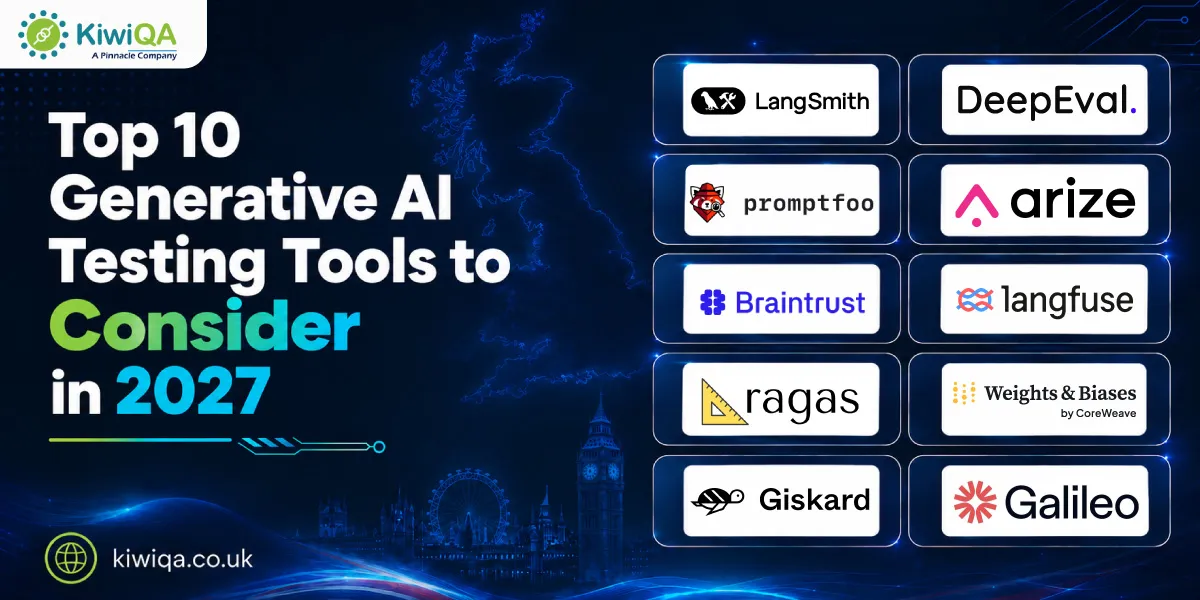
Top 10 Generative AI Testing Tools to Consider in 2027
1. LangSmith

LangSmith offers an easy way to trace the flow of execution, catch and analyze defects, and test the output of the application using the LangChain. Developers can also see how different parts of the workflow (e.g. a chain of reasoning based on the prompt and a few other tools, a set of agents making decisions, and a model providing a response) work in concert. Through the inspection of the execution logs, a developer can understand better how the AI handles the user’s query as well as how well it uses the various tools. They can also monitor the number of tokens consumed per conversation and compare the results of different prompts to find the best one.
2. DeepEval

DeepEval is an open-source tool for measuring and evaluating a LLM application via Python language only. It is, in fact, quite a testing framework because with it, you can build tests for AI-generated responses that you can repeat anytime. The ability to assess hallucinated content, answer relevancy, and other things such as toxicity, bias, etc., is what makes the tool so valuable. Being able to perform such evaluations as part of the CI/CD process, the developers will get to include the quality checks when developing the applications.
3. Promptfoo

Promptfoo is a tool targeted to developers for evaluating prompts, models, and AI responses, respectively. Teams can run comparisons between various prompts, and the platform offers security and red-teaming features for vulnerability detection that could be either prompt injection or unsafe output generation. Being able to install and run the tool quickly, it becomes very easy to include AI evaluation as part of development and CI/CD processes.
4. Arize Phoenix

Arize Phoenix is an open-source platform where you can run, debug, and evaluate generative AI applications. The features available in it make it easy for teams to see the entire request journey from the user to the LLM via agent workflows. This way, the developers can figure out why the LLM hallucinates or gives incorrect or odd responses, among other things. The system also allows teams to perform evaluations and create datasets simultaneously for continuous AI learning.
5. Braintrust

Braintrust delivers evaluation capabilities, testing tools, and observability features into one convenient platform. With Braintrust in their arsenal, it is quite effortless for development teams to compare different prompts, models, and outputs of AI while also keeping tabs on the evaluation metrics over time. For example, it allows a team to try out various prompt configurations in a testing environment prior to the deployment in real life. Version tracking, performance differences, and other features allow them to see clearly whether an update of some sort has actually brought a positive change in the quality of the AI application.
6. Langfuse

It is a platform for open source observability for large language models (LLMs) mainly. It captures prompts, responses, latency, token usage and user interaction data as part of its key data elements. Based on these analytics, the development team can identify costly/slow execution paths of workflows and investigate poor or unsatisfactory results, for instance. Moreover, the platform enables the addition of custom evaluations and feedback so that after deployment, one can still monitor the AI app.
7. Ragas

Ragas focuses exclusively on the evaluation of Retrieval-Augmented Generation (RAG) systems. Using the tool, teams would be able to check whether a given AI software finds useful data and accurately derives answers from such data context. Ragas’s evaluation metrics range from context precision to context recall, faithfulness, answer relevance, and so on. These functions help software developers detect and resolve issues with retrieval, document handling, and the generated response.
8. Weights & Biases (W&B) Weave

W&B Weave is essentially a collection of tools that can be employed to follow the flow of generative AI jobs, their monitoring and subsequent evaluation. The toolkit will bring the prompts, the outputs of model calls, a list of functions, and the final application output within the view of one’s operations team or developers. For instance, the latter can examine a trace together with a counterpart or look at what has evolved since the previous release of an AI app in order to assess the changes and their effects.
9. Giskard AI

Giskard is an open-source AI testing platform dedicated to finding technical, security, and responsible AI risks. For example, it can assist teams in the testing for hallucinations, bias, prompt injection, data leakage, and other potential problems. Once the system is set up, teams can start the automated scans and the test generation to get the first insights on weaknesses without wasting effort. This way, they can easily focus on fixing the issues. The final step will be to use the obtained info to guide the model to change its behavior and make AI applications secure.
10. Galileo AI

Galileo offers evaluation, monitoring, and guardrail features for applications of generative AI. This is useful for teams to evaluate factors like hallucination risk, context quality, toxicity, and prompt performance. Its production oriented features can be utilized for ongoing monitoring once deployed. With the integration of evaluation and guardrails, Galileo assists development teams in detecting problematic outputs and ensuring quality in scaling up AI applications.
Key Features to Look for in Generative AI Testing Tools
The ideal generative AI testing tools should enable them to be accurate, secure, scalable, and performant. Also, the top generative AI testing tools allow for ongoing testing and minimize errors in AI processes.
➥ AI Output Validation
The responses are validated against predefined requirements and inaccurate, irrelevant or misleading information is detected by AI output validation. Methods for semantic evaluation can compare generated answers to expected answers, and take into account variations in wording.
➥ Automated Test Case Generation
Automated test case generation is the process of generating synthetic inputs for testing AI applications at scale. It saves manual test writing workload and allows teams to test various user inputs, edge cases, and unexpected behaviours of the AI more effectively.
➥ Security and Risk Testing
Security testing can uncover vulnerabilities like prompt injection, jailbreak and exposure of sensitive information. Automated red-teaming capabilities can model a possible attack and alert teams to vulnerabilities before they impact production.
➥ Performance Monitoring
Performance monitoring tracks response times, latency, token usage and application scalability for various workflows. Ongoing monitoring can also point out how model behavior has changed and if performance is degraded early in the process.
How to Choose the Right Generative AI Testing Tool?
For the most effective generative AI testing tools, take into account security, scalability, integrations, and testing targets. The software testing tools are reliable generative AI testing tools for software testing, which can monitor the accuracy, performance, and costs of generative AI.
❏ Define Your AI Testing Requirements
Determine the type of AI application(s) and set accuracy, security, compliance, and performance goals. Consider testing volume and scalability needs. Customized AI testing solutions, an AI application testing service company, and AI consulting services for QA can simplify testing, and assist pick appropriate metrics.
❏ Evaluate Testing Capabilities
Check the AI models and endpoints that the tool is compatible with. Look for features such as automated evaluations, LLM-as-a-judge, semantic similarity checks, red-teaming, toxicity detection, and PII protection. These features enable teams to assess response quality and security risks.
❏ Consider Integration Support
Testing tools should work seamlessly with the existing QA frameworks, APIs, SDKs and development process. Support for Python or TypeScript, REST APIs and CI/CD platforms like Jenkins, GitHub Actions or GitLab CI may make implementation and automation easier.
❏ Analyze Cost and Scalability
Talk about open-source pricing vs. commercial pricing and infrastructure, training staff, maintenance. The tool chosen needs to scale with the volume of evaluations and deploy to multiple environments without adding unnecessary overhead for operations.
Also Read: Top 15 Agentic AI Testing Companies in the UK to Consider in 2026
Future Trends in Generative AI Testing for 2027
In 2027, the primary trends in generative AI testing will be increased automation, real-time monitoring, and responsible AI. Tests will be designed and run by autonomous testing agents and self-learning frameworks will adjust to changes in the models.
Automated compliance testing will enable changing regulations, and real-time guardrails will prevent undesirable and incorrect outputs. Multi-agent testing will also be useful in tracking agent communication, memory and tool utilization.

Ready to Choose the Right Generative AI Testing Tool for 2027?
The selection of the best generative AI software tools will depend on the project requirements, model complexity, and desired quality standards. The best Generative AI testing tools can be used to identify hallucinations, security vulnerabilities, performance problems and reliability issues before deployment.
AI testing consulting can assist in model evaluation and validation, and AI consulting services for QA can aid in creating scalable testing strategies. Automation and continuous testing go hand-in-hand to keep AI apps secure, accurate, compliant, and reliable in production.










Comments are closed.